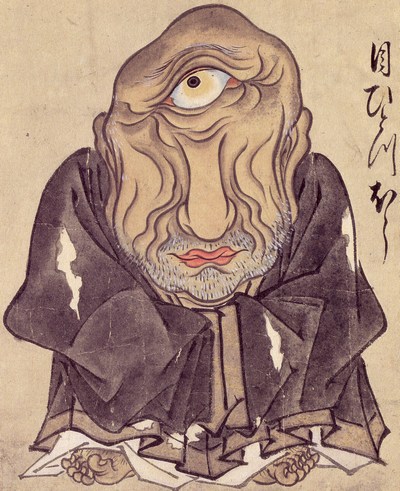
Hitotsume-nyudo
hitotsume-nyudo
Also known as: One-Eyed Monk、Cyclops Priest
A giant monk-shaped yokai with a single enormous eye in the center of its face, which appears on mountain roads and night paths. The hitotsume-nyudo combines the cyclops archetype with Japan's tradition of supernatural "nyudo" priest spirits.
- Era
- Edo Period
- Region
- Nationwide
- Type
- Road Yokai、Mountain Yokai
Overview
The hitotsume-nyudo — "one-eyed monk" or "single-eye priest" — is a road-haunting yokai that combines two powerful elements of Japanese supernatural tradition: the single-eyed creature (hitotsume) and the mysterious monk-shaped spirit (nyudo). It appears on mountain passes, dark roads, and isolated paths in the form of a large man with a shaved head and the robes of a Buddhist monk — but with a single massive eye occupying the center of its face where two normal eyes would be. The hitotsume-nyudo is part of a family of "nyudo" yokai that haunt Japan's roads, all sharing the unsettling characteristic of appearing in a form that combines religious authority with supernatural menace.
Appearance and Behavior
The hitotsume-nyudo presents as a large man — significantly taller than ordinary human proportions — dressed in Buddhist monk's robes with a shaved head. Its single eye is its most distinctive feature: positioned in the center of the forehead or face, it is described as large, luminous, and unsettling in its unblinking regard. The creature typically stands still on the road ahead of travelers, blocking passage or simply watching. If the traveler looks up to meet its eye — particularly if they try to see its face by craning their neck — some accounts report the creature growing taller in the manner of the mikoshi-nyudo and other size-shifting road spirits.
Encountering a hitotsume-nyudo and immediately looking downward, refusing to meet its gaze, is said to be the safest approach. Those who stare directly into the single eye risk being afflicted with illness or paralysis.
The One-Eyed in Japanese Tradition
The single eye holds significant symbolic weight in Japanese folk tradition. One-eyed creatures and deities appear throughout Japanese mythology and folklore as beings of supernatural power, their deviation from the bilateral symmetry of normal life marking them as occupying a different order of existence. The hitotsume-kozo (one-eyed child) is one of Japan's most widespread minor yokai types; the hitotsume-nyudo is an adult, more imposing version of the same essential concept.
Some scholars have connected the Japanese tradition of one-eyed supernatural beings to ancient deity beliefs in the Izumo region and elsewhere, where single-eyed gods were associated with divine sight — the ability to see into the spirit world or to perceive truths hidden from ordinary human perception.
The Nyudo Family
The hitotsume-nyudo belongs to the loose category of "nyudo" road yokai that inhabit Japanese folk tradition alongside the mikoshi-nyudo, taka-nyudo, and others. These spirits share the disguise of a Buddhist monk — a figure associated with spiritual authority and safe passage — but reveal that authority as fundamentally threatening. The use of the monk's form may reflect the ambivalent attitude toward religion in popular culture: the monk is powerful, but that power is not necessarily aligned with human welfare.
Cultural Significance
As a synthesis of two robust yokai traditions — the one-eyed being and the monk spirit — the hitotsume-nyudo represents the combinatorial creativity of Japanese folk supernatural tradition, where established types could be merged to create new variants suited to local environments and specific fears.
Sources
- 『Kasshi Yawa』 Matsura Seizan (1821)
Related Yokai
Abura-Sumashi
abura-sumashi
A straw-cloaked figure on a Kumamoto pass who declares his ancestor haunted it.

Azuki-Babaa
azuki-babaa
A dangerous old-woman yokai who scrapes azuki beans in mountain streams. Related to the azuki-arai but more specifically formed and more actively threatening.
Betobeto-San
betobeto-san
An invisible yokai that follows travelers on dark roads, heard only as footsteps behind them. Saying "go ahead of me" makes it disappear.