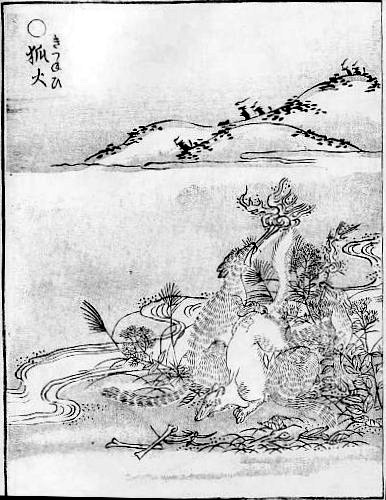
Kitsunebi
kitsunebi
Also known as: Fox Fire、Fox Lantern
Mysterious lights produced by foxes appearing in long processions across nighttime fields. Famous as the illumination of the "fox wedding," kitsunebi is a classic Japanese supernatural light phenomenon.
- Era
- Unknown
- Region
- Nationwide
- Type
- Fire Yokai、Animal Yokai
Overview
Kitsunebi — "fox fire" or "fox light" — refers to the mysterious flames or glowing lights that foxes are said to produce from their mouths or the tips of their tails. In Japanese folk tradition, the fox possesses supernatural abilities including shape-shifting, illusion-casting, and the power to generate ghostly fire. When large numbers of foxes gather and travel together at night, each carrying its flame, the resulting procession of lights crossing a dark field or hillside became one of the most frequently reported supernatural phenomena of pre-modern Japan.
The Fox Wedding
The most celebrated manifestation of kitsunebi is the "kitsune no yomeiri" — the fox wedding procession. In Japanese tradition, when rain falls while the sun is shining (the equivalent of "the devil's wedding" in Western idiom), it is called a "fox wedding." The nighttime equivalent involves a long procession of kitsunebi lights moving in an orderly line across fields or mountain slopes, representing a fox bridal party traveling to a wedding ceremony. Observers who saw such processions were advised to stay indoors and not interfere, as disturbing a fox wedding was considered extremely inauspicious.
The Musashino plain (encompassing modern Tokyo and surrounding prefectures) was particularly famous for kitsunebi sightings, and the phenomenon is recorded in numerous Edo period diaries, travelogues, and collections of curiosities. Matsura Seizan's Kasshi Yawa (1821) contains detailed observations of hundreds of lights moving in organized patterns across the fields of Musashino, recorded by multiple independent witnesses.
Fox Fire in Folk Belief
The ability to produce fire connects to the fox's broader status in Japanese supernatural tradition. Foxes are the sacred messengers of Inari, the deity of rice, fertility, and prosperity, and fox shrines (Inari shrines) are the most numerous shrine type in Japan. But foxes are simultaneously feared as powerful tricksters capable of possessing humans, creating dangerous illusions, and luring travelers to their deaths. Kitsunebi embodies this dual nature: the same fire that guides the fox procession can also lead a lone traveler deeper into darkness and confusion.
Natural Explanations and Cultural Legacy
Like the onibi and other Japanese ghost fires, kitsunebi has been explained by naturalists as the bioluminescence of fungi or insects, or as the ignition of marsh gas in environments where foxes commonly hunt. The specific association with foxes rather than ghosts may reflect observation of foxes actually hunting near glowing marshes at night. Whatever its physical origins, the tradition of fox fire has become deeply embedded in Japanese aesthetics — appearing in woodblock prints by Hiroshige, in haiku poetry, and throughout modern Japanese visual culture as a symbol of mysterious, liminal nocturnal beauty.
Sources
- 『Wakan Sansai Zue』 Terajima Ryoan (1713)
- 『Kasshi Yawa』 Matsura Seizan (1821)
Related Yokai
Baku
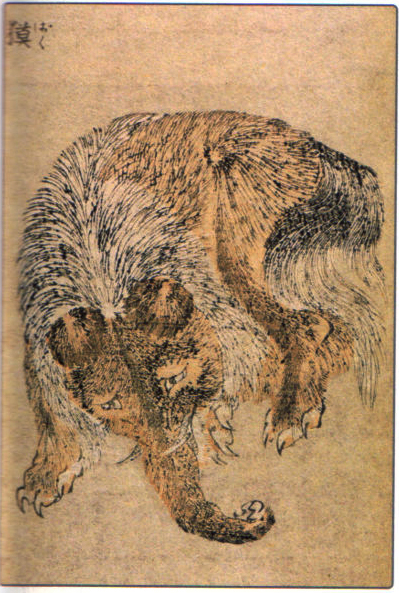
baku
A chimeric dream-eater invoked after nightmares to consume ill omens.
Basan
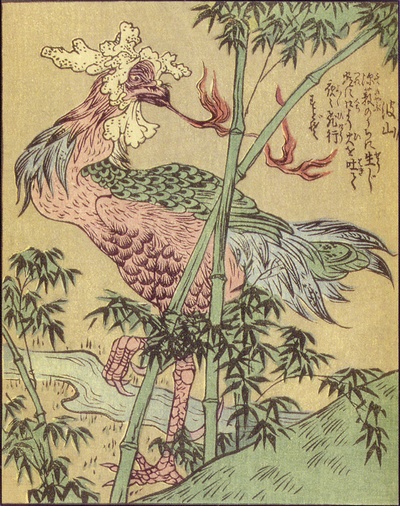
basan
A fire-breathing rooster yokai from the Kinki and Chūgoku regions of Japan. It appears at night with a distinctive flapping sound, breathes flames, and vanishes before anyone can get a clear look at it.
Enenra
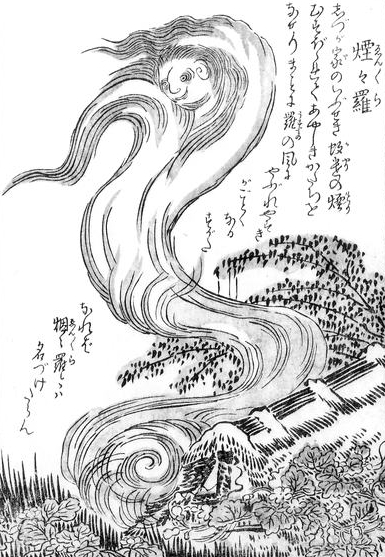
enenra
A supernatural entity that lives in smoke and manifests as a writhing form within flames or incense. First depicted by Toriyama Sekien, the enenra emerges from smoke as a face or figure of impossible definition.