Overview
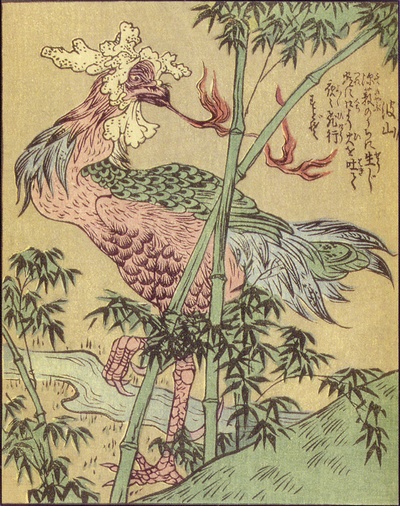
The basan is a yokai taking the form of a large, flame-breathing rooster, recorded and illustrated by Toriyama Sekien in his landmark collection Gazu Hyakki Yagyō (1776). Said to inhabit mountain regions in the Kinki and Chūgoku areas of western Japan (roughly encompassing the modern prefectures of Osaka, Kyoto, Hyogo, Hiroshima, and Yamaguchi), the basan appears at night, beating its wings with a distinctive "basa-basa" sound — from which its name is likely derived — and breathing fire into the darkness before disappearing without a trace.
Appearance and Characteristics
Sekien's illustration depicts the basan as a large, rooster-like bird with a prominent red comb, shown against a background of swirling flames. Its body and features are recognizably chicken-like, but the fire emanating from its beak and surrounding its form marks it as something far from ordinary. The creature reportedly makes an eerie, unusual cry when it appears near villages at the edge of mountain forests.
Accounts describe the basan as elusive: people who hear its wingbeats and see the glow of its flames and go to investigate find nothing — the creature vanishes into the dark as quickly as it appeared. It is not generally described as attacking humans directly; rather, it spreads fear through its alien appearance and the inexplicable fire it produces.
Regional Legends
The Iyo region of Ehime Prefecture (formerly Iyo Province, part of Shikoku) preserves a particularly rich tradition of basan encounters. Multiple accounts describe villagers hearing strange bird cries and seeing mysterious lights near mountain paths late at night, with the basan identified as the source. These stories reflect the general anxiety surrounding the boundary between cultivated lowland villages and the dark, untamed mountain wilderness.
The Rooster, the Sun, and the Supernatural
The choice of a rooster as the form of this yokai carries cultural resonance. In Japanese and broader East Asian tradition, the rooster is intimately connected with the sun and the dawn, its crow heralding the return of light and driving away the spirits of night. A rooster that breathes fire and inhabits the darkness represents an inversion of this sacred role — a creature that wields the sun's power in a corrupt or demonic form.
Similar fire-bird traditions exist across East and Southeast Asia, and the basan may reflect a shared cultural substrate of flame-bird belief that entered Japanese yokai lore through continental contact or parallel development.
Sekien's Role in Codifying the Basan
Toriyama Sekien's decision to include the basan in Gazu Hyakki Yagyō was instrumental in elevating this regional yokai to national recognition. Sekien's encyclopedic illustrations served as a kind of visual taxonomy of Japanese supernatural creatures, and many yokai known today owe their canonical visual form to his work. The basan is an excellent example of a locally specific monster tradition transformed into a broadly recognized yokai through Sekien's artistic synthesis.