
Sodehiki-Kozo
sodehiki-kozo
Also known as: sleeve-puller boy
An invisible yokai that tugs at the sleeves of lone travelers on dark roads at night, known only by its unseen touch.
- Era
- Edo Period
- Region
- Nationwide
- Type
- Road Yokai
Overview
The sodehiki-kozo ("sleeve-pulling boy") is a yokai defined entirely by what it does rather than what it looks like. Walking alone on a dark road, a traveler suddenly feels their sleeve — the wide, draped sleeve of a traditional kimono — grabbed and pulled by an unseen hand. Turning around reveals nothing. Nobody is there. Yet the sensation is unmistakable.
The name implies a small, child-sized entity, but no reliable sighting has ever fixed its appearance. It is purely a tactile yokai, known only through touch.
Behavior and Encounters
Reports of sleeve-pulling encounters cluster around lonely night roads, bridge approaches, and dimly lit alleyways — liminal spaces where the boundary between the everyday world and the supernatural feels thin. The yokai does not speak, does not threaten, and causes no direct harm. It simply pulls, startles, and disappears.
Despite its apparently harmless nature, the sodehiki-kozo has been blamed for indirect accidents: a startled traveler stumbling off a bridge, or losing footing on a steep path. The moment of shock, not malice, is the danger.
Folklore Interpretation
Scholars of Japanese folklore, including Kunio Yanagita, have noted a broad category of "tactile yokai" — supernatural entities that manifest not visually but through physical sensation alone. The sodehiki-kozo belongs squarely in this tradition. The experience of being touched by something invisible taps into a primal fear: the darkness that hides what the eyes cannot see.
The "kozo" (boy) element of the name connects the yokai to a wider cluster of child-ghost folklore. Bridges and crossroads, where the encounters most often happen, carry strong associations in Japanese folk belief as thresholds between worlds — places where spirits of lost children might linger, reaching out to the living.
Legacy
Even today, the experience of feeling an invisible tug on one's clothing is among the most commonly reported types of supernatural encounter in Japan. The name sodehiki-kozo may not always be invoked, but the phenomenon it describes — the unseen hand in the dark — remains a persistent part of Japanese ghost lore.
Sources
- 『Yōkai Dangi』 Kunio Yanagita (1956)
Related Yokai

Abura-Sumashi
abura-sumashi
A straw-cloaked figure on a Kumamoto pass who declares his ancestor haunted it.
Betobeto-San
betobeto-san
An invisible yokai that follows travelers on dark roads, heard only as footsteps behind them. Saying "go ahead of me" makes it disappear.
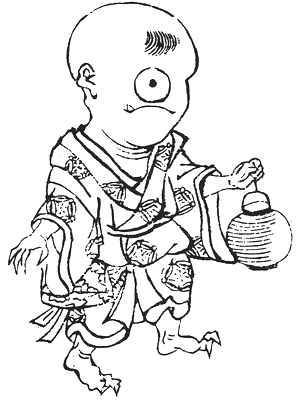
Hitotsume-kozō
hitotsume-kozo
A child-monk yokai with a single large eye in the center of its face, associated with certain calendar days and known to fear objects with many holes.