Taka-nyudo
taka-nyudo
Also known as: Tall Monk、Towering Priest
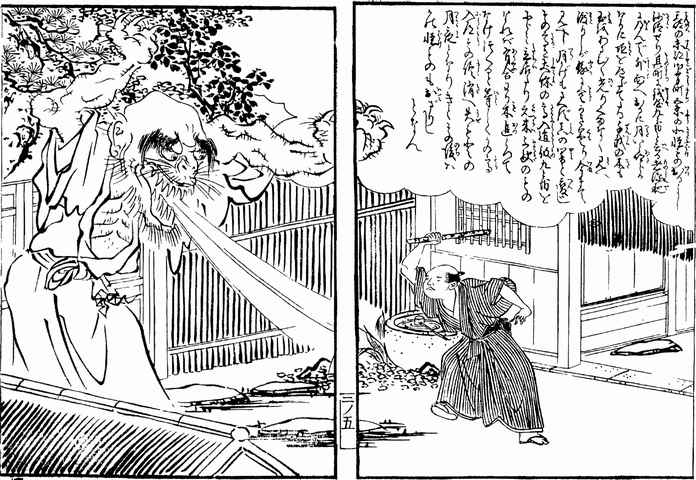
A giant monk-shaped yokai that suddenly appears on mountain roads and grows taller as travelers look up at it. A classic Japanese road spirit of the "looming priest" type.
- Era
- Edo Period
- Region
- Nationwide
- Type
- Road Yokai、Mountain Yokai
Overview
The taka-nyudo, meaning "tall priest" or "towering monk," is a yokai that materializes on mountain passes and dark roads in the form of an enormous monk-like figure. Its defining characteristic is that it grows taller the higher one looks up at it, with its head always seemingly just out of sight above the treeline or the cloud cover. The taka-nyudo belongs to the broad family of "nyudo" (monk-shaped) yokai that haunt Japanese roads, which includes the more famous mikoshi-nyudo and the hitotsume-nyudo. These spirits share the quality of appearing as men of religious appearance who have been transformed — or who were never human — into beings of supernatural size.
Appearance and Behavior
The taka-nyudo appears at first as a large but not impossible figure standing in the road or on a hillside ahead. As the traveler notices it and instinctively looks upward to find its face, the creature grows — stretching its body to match and exceed whatever height the traveler's gaze ascends to. The face, when glimpsed, is described as that of a shaved-headed monk of extreme age or hideous deformity, with eyes that catch whatever moonlight is available and gleam with cold intelligence. The taka-nyudo does not typically attack physically; rather, it causes intense fear and disorientation, and travelers who encounter it may be found the next morning collapsed on the road, unable to remember what happened.
Regional Traditions
Accounts of the taka-nyudo appear across many regions of Japan, with particular concentrations in mountain districts of central Honshu where mountain passes served as important — and feared — transit points. Matsura Seizan's Kasshi Yawa records multiple contemporary accounts of such encounters, suggesting that belief in road-haunting giant monks was widespread among Edo-period people of all social classes. The specific behavior of the spirit growing taller as one looks up is consistent across accounts from widely separated regions, indicating a coherent tradition rather than isolated local invention.
The Nyudo Family of Yokai
The taka-nyudo is one of several "nyudo" yokai that populate Japanese road folklore, all sharing the form of a large, shaved-headed monk figure. The monk's form may have been chosen because Buddhist priests were associated with spiritual power, liminality between life and death, and the ability to traverse dangerous spaces that ordinary people feared. A supernatural being taking the monk's form would represent the inversion of that spiritual protection — a being that mimics the sacred while delivering terror instead of comfort.
Cultural Significance
The taka-nyudo, along with its relatives the mikoshi-nyudo and hitotsume-nyudo, represents the Japanese tradition of road spirits that embody the dangers of nighttime mountain travel. In an era before reliable lighting or infrastructure, mountain passes were genuinely dangerous places where people could become lost, fall, or encounter wildlife. Yokai like the taka-nyudo gave form and narrative to these very real dangers, making the threat comprehensible and, in a sense, manageable within a framework of folk belief and protective practice.
Sources
- 『Kasshi Yawa』 Matsura Seizan (1821)
Related Yokai
Abura-Sumashi
abura-sumashi
A straw-cloaked figure on a Kumamoto pass who declares his ancestor haunted it.

Azuki-Babaa
azuki-babaa
A dangerous old-woman yokai who scrapes azuki beans in mountain streams. Related to the azuki-arai but more specifically formed and more actively threatening.
Betobeto-San
betobeto-san
An invisible yokai that follows travelers on dark roads, heard only as footsteps behind them. Saying "go ahead of me" makes it disappear.