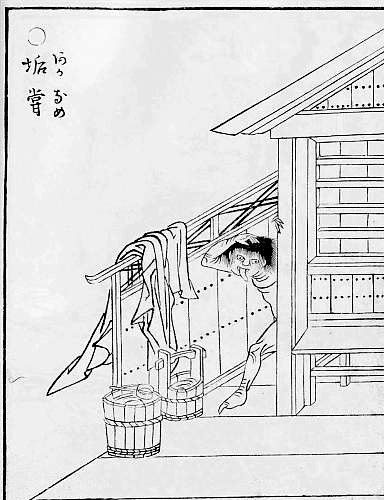
Aka-name
aka-name
Also known as: Filth Licker、Scum Licker
A yokai that visits neglected bathrooms to lick up the accumulated grime and scum — harmless to people, but a vivid supernatural reminder to keep the bath clean.
- Era
- Edo Period
- Region
- Nationwide
- Type
- House Yokai
Overview
Aka-name, whose name means "filth licker" or "scum licker," is a yokai that haunts bathrooms, bath tubs, and washing areas left dirty and neglected. It appears in Toriyama Sekien's Gazu Hyakki Yagyō as a small, frog-like creature with an enormously long tongue, which it uses to lick up the accumulated body oils, soap scum, and grime from the surfaces of an unclean bath. Critically, the aka-name poses no threat to humans — it only wants the dirt. Its purpose in Japanese folk belief is less to terrify than to motivate.
Appearance
Sekien's illustration shows a small, hunched creature with large bulging eyes, a wide mouth, and an extraordinarily long tongue trailing behind it. Its skin is described as damp and slimy, with a color somewhere between green and gray that suggests something amphibious and unwholesome. Its fingers are sometimes depicted with suckers that allow it to cling to tile and wood surfaces. It reeks, which is the first warning a person typically receives that their bathroom has become a suitable habitat for this visitor.
Ritual Purity and Domestic Space
The aka-name belongs to a cluster of Japanese yokai that inhabit neglected or impure domestic spaces. In Japanese folk religion, the distinction between clean (kiyome) and unclean (kegare) is not merely physical but spiritual — a space that has accumulated dirt and grime has also accumulated a kind of spiritual impurity that attracts supernatural entities. Keeping one's home clean, especially spaces associated with the body and its wastes, is therefore a form of spiritual hygiene as much as physical hygiene. The aka-name makes this principle concrete and, in its cheerfully gross way, memorable.
The Harmless Yokai as Social Teacher
The aka-name is a classic example of what might be called the "cautionary yokai" — a supernatural being that enforces social norms not through violence but through the mere fact of its existence. You won't be hurt by an aka-name, but would you really like to share your bath with one? This type of yokai served important social functions in pre-modern Japan, reinforcing community standards of behavior and hygiene through supernatural storytelling rather than explicit instruction. Today the aka-name appears frequently in children's media and educational contexts, its legacy as a motivator for bathroom cleaning fully intact.
Sources
- 『Gazu Hyakki Yagyō』 Toriyama Sekien (1776)
Related Yokai
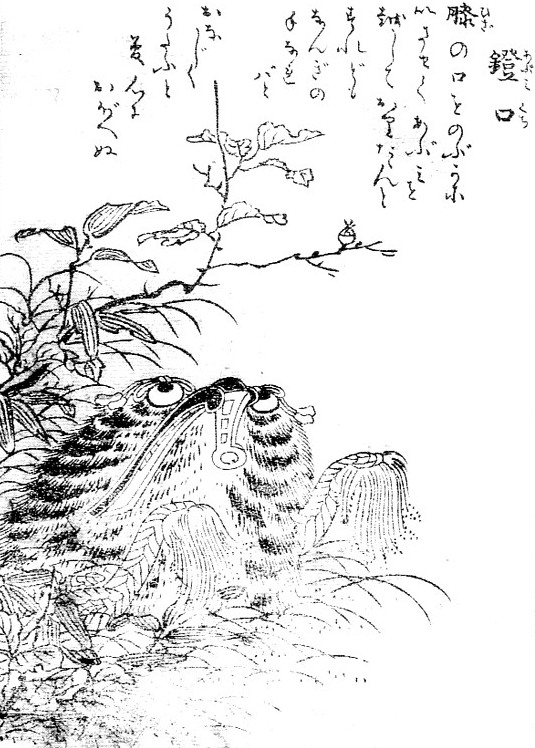
Abumi-guchi
abumi-guchi
A tsukumogami born from a horse's stirrup abandoned on a battlefield, still waiting for the master who never returned — grief and loyalty made monstrous.
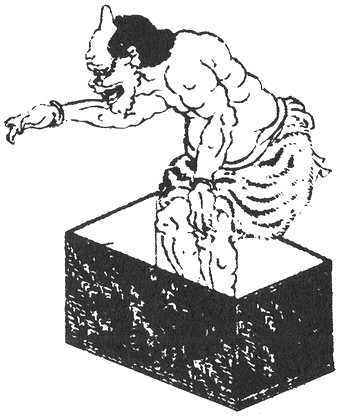
Amanojaku
amanojaku
A small, perverse demon that reads human hearts and does the opposite of what is desired. Famous as the villain of folk tales like Uriko-hime, and depicted in Buddhist sculpture as a creature trampled underfoot by guardian deities.
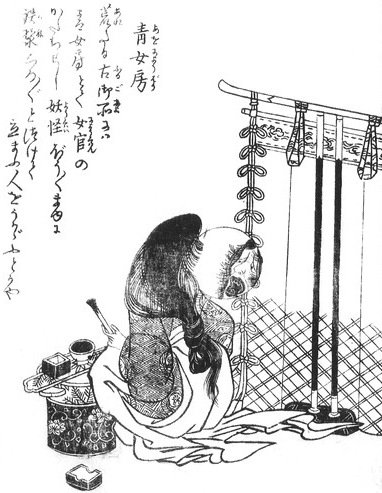
Aonyōbō
aonyobo
The spirit of a Heian court lady who haunts ruined aristocratic mansions, still applying her blackened teeth makeup centuries after her death.