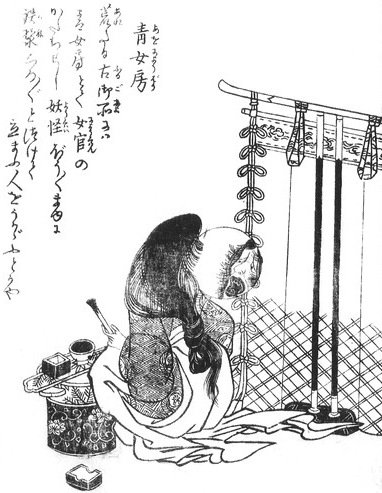
Aonyōbō
aonyobo
Also known as: blue court lady、pale noblewoman
The spirit of a Heian court lady who haunts ruined aristocratic mansions, still applying her blackened teeth makeup centuries after her death.
- Era
- Heian Period
- Region
- Kinki
- Type
- House Yokai、Undead
Overview
The Aonyōbō ("blue court lady") is a haunting figure from Japanese folklore — the ghost of a noblewoman who once served in the imperial court, now unable to leave the ruins of the mansion where she once lived. Centuries have passed, the building has rotted and collapsed around her, but she continues performing her toilette: applying the blackened-teeth makeup (ohaguro) that was the mark of a refined court lady, combing her disheveled hair, adjusting her faded and tattered twelve-layered robes. Toriyama Sekien depicted her in Konjaku Hyakki Shūi (1781) as a luminously pale woman performing these ghostly ablutions amid falling timbers.
Appearance
The Aonyōbō's form retains the shape of the aristocratic beauty she once was — but everything is wrong. Her skin has taken on a bluish or pallid cast (the "ao" of her name can mean "blue," "green," or simply "pale"). Her elaborate court robes, once the pinnacle of Heian fashion, are now rags, their colors faded to gray and brown. Yet she continues to apply her ohaguro — the complex preparation of iron-based black dye used to stain the teeth — with the same careful attention she would have given it in life. The blackened teeth stand out against her pale face like a wound.
The Heian Court and Its Ghosts
The Heian period (794–1185) was Japan's golden age of aristocratic culture. Its court was the center of everything refined, aesthetic, and powerful. But the period ended, and the great manors that housed the court nobility crumbled over subsequent centuries. The Aonyōbō belongs to that moment of decay — she is the human face of a culture that refused to admit it had ended. Her continued application of ohaguro is both poignant and horrifying: a woman so defined by her social role that she cannot stop performing it even after death, even in ruins.
Ohaguro as Symbol
Ohaguro, the practice of blackening one's teeth, was practiced in Japan from ancient times and was especially associated with the Heian aristocracy and, later, with married women. For the Aonyōbō, the ongoing application of ohaguro signifies several things simultaneously: her refusal to accept her own death, her attachment to a social identity that no longer exists, and the stubbornness of aesthetic habit in the face of total dissolution. It also marks her as a figure of a specific historical moment — a ghost not just of a person, but of an era.
Legacy
The Aonyōbō appears in period dramas, ghost story anthologies, and modern horror media as a figure of melancholy horror. Her tragedy is not simply that she is a monster, but that she is a woman trapped by attachment — to status, to beauty, to a world that has passed her by.
Sources
- 『Konjaku Hyakki Shūi』 Toriyama Sekien (1781)
- 『Konjaku Monogatari-shū』 Various (1120)
Related Yokai
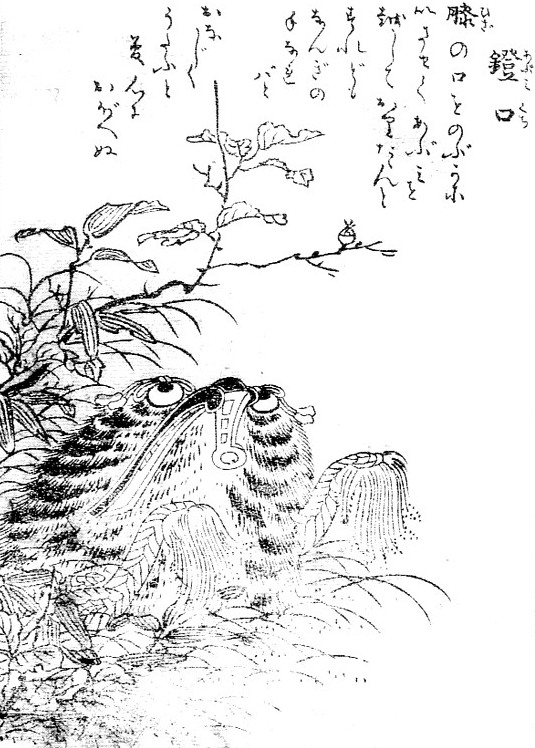
Abumi-guchi
abumi-guchi
A tsukumogami born from a horse's stirrup abandoned on a battlefield, still waiting for the master who never returned — grief and loyalty made monstrous.
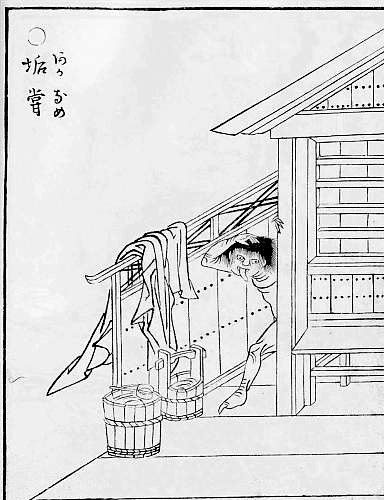
Aka-name
aka-name
A yokai that visits neglected bathrooms to lick up the accumulated grime and scum — harmless to people, but a vivid supernatural reminder to keep the bath clean.
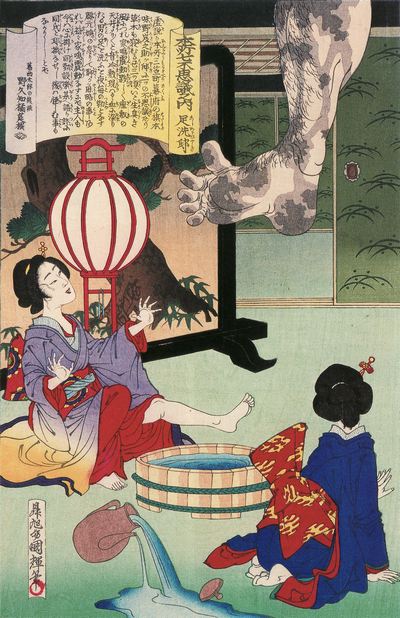
Ashiarai Yashiki
ashiarai-yashiki
A haunted Edo mansion terrorized by an enormous disembodied foot that crashes through the ceiling demanding to be washed. This famous Edo kaidan is one of Japan's most distinctively absurd ghost stories.