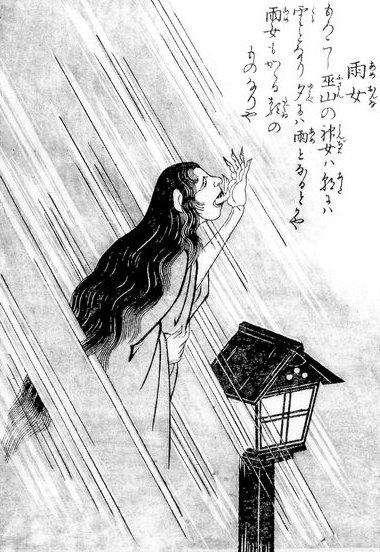
Ame-onna
ame-onna
Also known as: rain woman、woman of the rain
A woman yokai associated with rainfall, appearing on rainy nights as a drenched figure sometimes carrying an infant, connected to both weather spirits and the spirits of women who died in childbirth.
- Era
- Edo Period
- Region
- Nationwide
- Type
- Weather Yokai
Overview
The Ame-onna ("rain woman") is a female yokai whose existence is inextricably tied to rain. She appears during rainstorms or on rainy evenings, manifesting as a soaking-wet woman who stands in the rain or wanders through it. Toriyama Sekien depicted her in Konjaku Hyakki Shūi (1781) as a woman holding an infant while rain falls around her, her eyes vacant with grief or longing. The Ame-onna has connections to multiple strands of Japanese folklore: weather spirits, the rain deity traditions inherited from Chinese cosmology, and the particularly potent spirits of women who died during or after childbirth.
Appearance
The Ame-onna appears as a young or middle-aged woman, completely drenched from head to toe. Her hair clings to her face and neck; her robes are heavy and transparent with water. She does not seek shelter. She stands in the rain or walks through it as if it is her natural state — which, in a sense, it is. In Sekien's famous illustration, she holds a swaddled baby, her expression far away. The combination of a mother-figure, the desolation of the rain, and the vacancy in her eyes suggests a ghost story more than a simple weather spirit.
Origins and Interpretations
The Ame-onna's origins are multiple and somewhat tangled. One thread connects her to the Chinese concept of a rain master or rain deity, which was absorbed into Japanese religious and cosmological thinking during the Nara and Heian periods. In this interpretation she is a supernatural being who can summon or stop rain, a weather spirit of considerable power. A second, more specifically Japanese thread connects her to women who died in childbirth — souls bound to the earth by their unfinished maternal attachment, drawn to rain because of its associations with tears, with the boundary between life and death, and with the floods that periodically threatened agricultural communities.
Rain Rituals and Women
In many of Japan's traditional rain-calling (amagoi) ceremonies, women played central roles. The idea that women had a special connection to water and rainfall — deriving perhaps from the association of women with the moon and its tidal influences — gave female rain figures like the Ame-onna a plausible foundation in lived religious practice. The yokai is thus not a pure invention but a crystallization of real ritual beliefs.
Modern Usage
In contemporary Japanese, "ame-onna" (or "ame-otoko" for men) refers colloquially to a person who always seems to bring rain wherever they go — someone whose outings are invariably rained upon. This secular usage preserves the ancient concept in everyday language, stripped of its supernatural terror but retaining the essential idea of a person with an unusual relationship to rain.
Sources
- 『Konjaku Hyakki Shūi』 Toriyama Sekien (1781)
- 『Wakan Sansai Zue』 Terajima Ryōan (1713)
Related Yokai
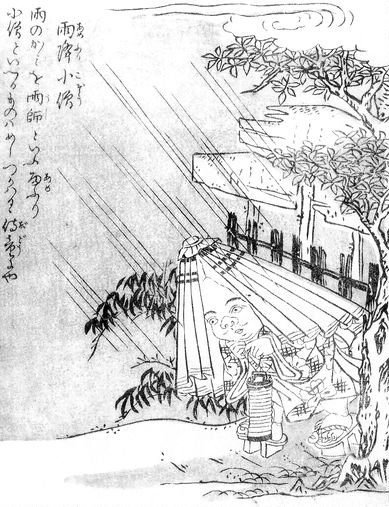
Amefuri-Kozo
amefuri-kozo
A rain sprite from Edo-period illustration, depicted as a small boy in a straw hat and rain cloak whose appearance heralds or brings rainfall.
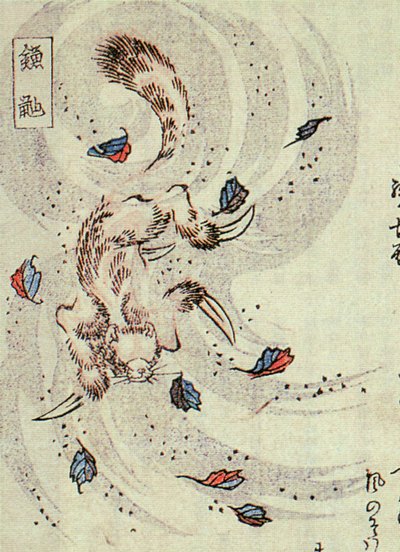
Kamaitachi
kamaitachi
A trio of weasel yokai from central Japan said to ride whirlwinds and slash travelers with razor-sharp claws. Victims find bloodless wounds on their legs with no memory of pain, typically after a sudden gust of wind.
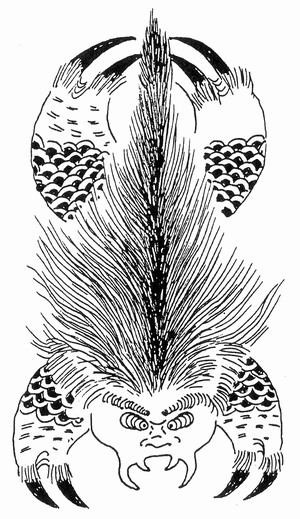
Raiju
raiju
A mysterious beast said to descend from the sky during thunderstorms. Its form varies by region — weasel, raccoon dog, cat, or monkey — but it always bears sharp claws and carries the destructive energy of lightning.