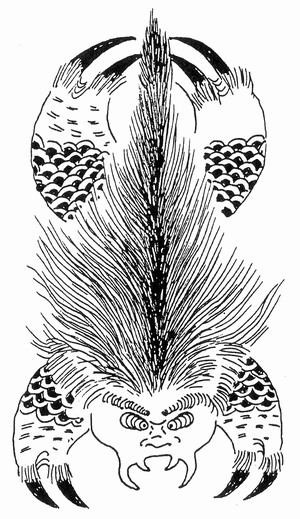
Raiju
raiju
Also known as: Thunder Beast、Lightning Animal
A mysterious beast said to descend from the sky during thunderstorms. Its form varies by region — weasel, raccoon dog, cat, or monkey — but it always bears sharp claws and carries the destructive energy of lightning.
- Era
- Unknown
- Region
- Nationwide
- Type
- Weather Yokai、Animal Yokai
Overview
The raiju is a supernatural creature believed to fall from the sky during thunderstorms, riding the lightning down to earth. Its name means "thunder beast" (雷獣), and accounts of its appearance and capture appear in natural histories, illustrated encyclopedias, and popular broadsheets throughout the Edo period. Unlike many yokai whose forms are fixed by canonical illustrations, the raiju has no single definitive appearance — it was described as resembling a tanuki, a weasel, a cat, a monkey, a squirrel, or some combination thereof, depending on the region and the account. What all versions share is an association with electricity, sharp claws, and the raw power of the storm.
Appearance and Characteristics
The Wakan Sansai Zue (1713), a major Japanese encyclopedia modeled on Chinese encyclopedic traditions, describes the raiju as resembling a tanuki with unusually sharp claws. Edo-period illustrated broadsheets (kawaraban) often depicted recently "captured" raiju, each with a different form, suggesting that various unknown or unfamiliar animals discovered after storms were labeled as raiju. The creature's body was said to crackle with electrical energy, and it could set fire to trees and structures by contact alone.
One of the raiju's most distinctive traits is the claw marks it was said to leave on trees struck by lightning. The splitting and scorching patterns left by a lightning strike could easily suggest claw marks to a premodern observer, lending physical "evidence" to the raiju's existence.
Relationship to the Thunder God
The raiju was sometimes described as the companion or messenger of Raijin, the Japanese god of thunder, who is typically depicted as an oni-like figure beating a ring of drums to create thunder. In this interpretation, the raiju accompanies its master through the storm, running ahead of thunderbolts or being cast down with them. The connection to divine power gave the raiju a more awe-inspiring dimension than simple monster status — it was part of the storm itself, an agent of heaven.
In some traditions, sleeping outdoors during a thunderstorm was dangerous because the raiju might land on or near a sleeping person and injure them with its claws. This gave rise to folk customs of hiding one's navel (heso) during storms, as the raiju was said to be especially attracted to belly buttons.
Regional Traditions
Raiju legends are especially common in the mountainous regions of Echigo (modern Niigata) and Shinshū (Nagano), areas known for dramatic electrical storms. The Kasshi Yawa essay collection records stories of raiju being captured and displayed as curiosities, or sent to natural historians for examination, reflecting an Edo-era quasi-scientific interest in these creatures alongside the folk belief.
Scientific Perspective
Modern interpretations suggest that various animals discovered disoriented or sheltering after storms — flying squirrels, martens, badgers — were misidentified as raiju. Physical phenomena associated with lightning strikes, including the splitting of trees, vitrified sand deposits (fulgurites), and scorch patterns, provided apparent "evidence" that validated the belief. The raiju represents a fascinating example of how premodern natural philosophy and supernatural belief intersected in the explanation of dramatic weather events.
Sources
- 『Wakan Sansai Zue』 Terajima Ryōan (1713)
Related Yokai
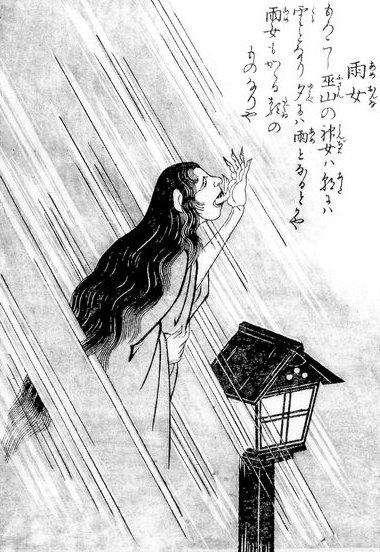
Ame-onna
ame-onna
A woman yokai associated with rainfall, appearing on rainy nights as a drenched figure sometimes carrying an infant, connected to both weather spirits and the spirits of women who died in childbirth.
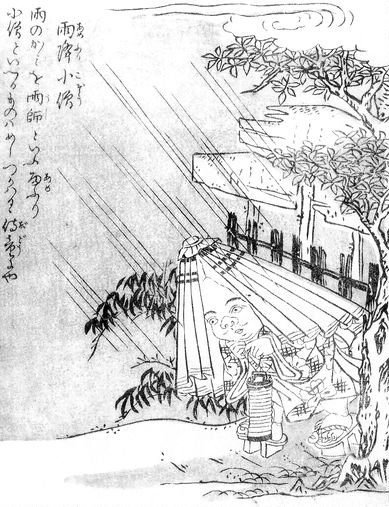
Amefuri-Kozo
amefuri-kozo
A rain sprite from Edo-period illustration, depicted as a small boy in a straw hat and rain cloak whose appearance heralds or brings rainfall.
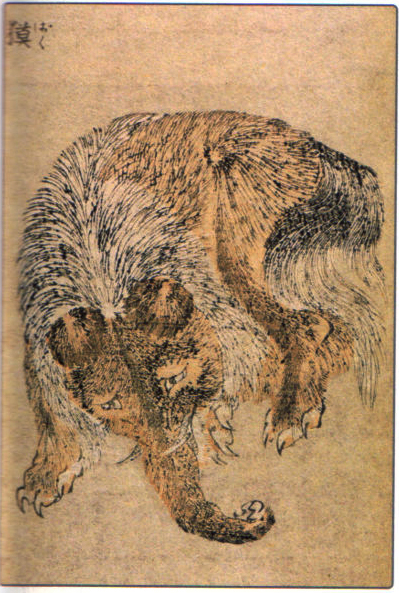
Baku
baku
A chimeric dream-eater invoked after nightmares to consume ill omens.