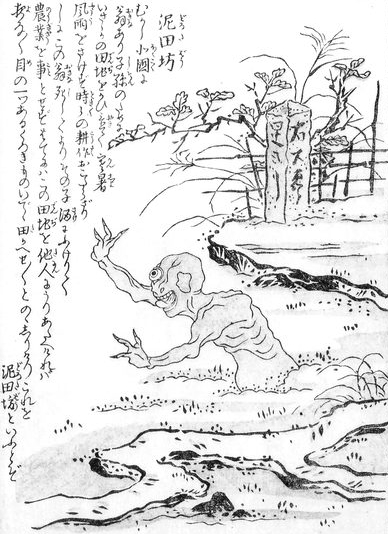
Dorotabō
dorotabo
Also known as: mud-field monk、paddy ghost
The vengeful spirit of an old farmer whose children sold his beloved rice paddies, rising from the mud at night with three-fingered hands raised, crying for his fields to be returned.
- Era
- Edo Period
- Region
- Nationwide
- Type
- Water Yokai、Undead
Overview
The Dorotabō ("mud-field monk" or "paddy-field ghost") is one of the most emotionally resonant yokai in the Japanese tradition — not a creature born of the wilderness or the supernatural unknown, but the ghost of a specific human tragedy: a farmer who devoted his life to cultivating his rice fields, only to have them sold by his ungrateful children after his death. Toriyama Sekien depicted him in Gazu Hyakki Yagyō (1776) as a mud-encrusted old man rising from the waterlogged earth of a rice paddy, one eye in his weathered face, his three-fingered hands raised to the sky in a gesture of desperate appeal. He cries out in the night: "Give back my fields!"
Appearance
The Dorotabō emerges from the mud with his upper body: an ancient, gaunt man plastered with dark earth and water. His face has a single eye — the other perhaps lost to age or suffering — and his expression conveys not rage but bottomless anguish. His hands are notable: each has only three fingers, a detail that contributes to his otherworldly appearance while retaining his essential humanity. He does not chase or attack; he rises, reaches upward, and cries.
The Farmer's Attachment
The story behind the Dorotabō reflects the profound relationship between Japanese farmers and their land. Rice cultivation in pre-modern Japan was extraordinarily labor-intensive, requiring the transformation of wild terrain into precisely leveled, carefully irrigated fields over years or decades. A farmer who cleared and built his paddies from scratch invested not just labor but identity into that land. To have it sold — especially by one's own children — after death was to have one's life's work erased and one's memory dishonored. The Dorotabō's haunt is not malicious; it is grief made visible.
Filial Piety and Its Violation
The Dorotabō is explicitly a tale about the violation of filial piety, one of the most important values in Edo-period Japanese (and more broadly Confucian-influenced) ethics. Children were expected to honor their parents' memories and preserve their legacies. Selling off the family land was among the most flagrant betrayals of this duty imaginable. The Dorotabō does not punish his children directly in most versions of the story — he simply mourns, publicly and eternally, making the wrong undeniable.
Agricultural Religion
Rice paddies in Japan have always had spiritual dimensions. The deity of the rice field (ta no kami) was among the most widely worshipped in Japanese folk religion, and the boundary between a working paddy and a haunted one was thin. The Dorotabō fits naturally into this framework: the field that was the center of a man's spiritual and economic life becomes, after betrayal, the site of his haunting. He is literally rooted there.
Sources
- 『Gazu Hyakki Yagyō』 Toriyama Sekien (1776)
Related Yokai
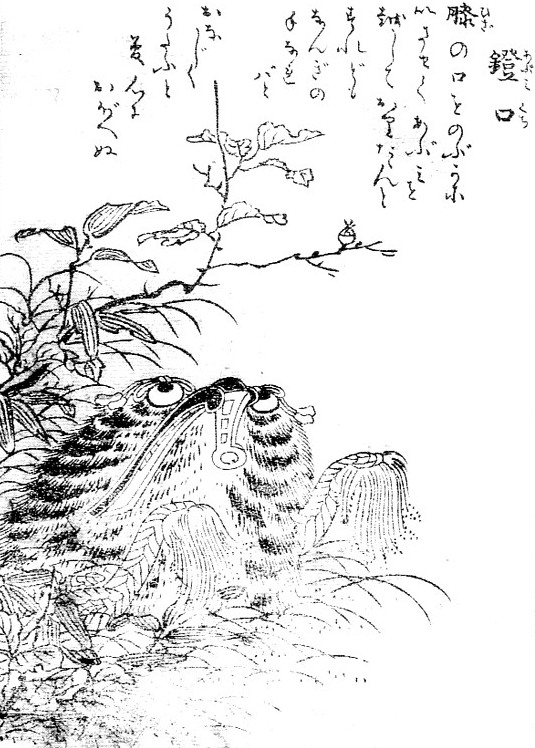
Abumi-guchi
abumi-guchi
A tsukumogami born from a horse's stirrup abandoned on a battlefield, still waiting for the master who never returned — grief and loyalty made monstrous.
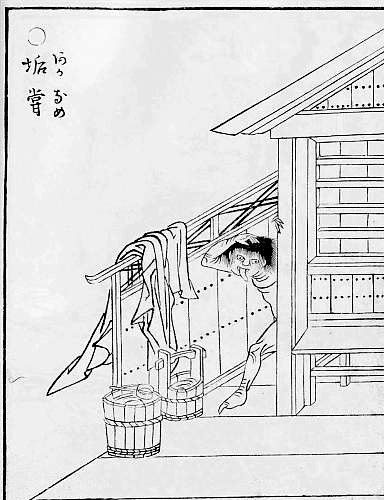
Aka-name
aka-name
A yokai that visits neglected bathrooms to lick up the accumulated grime and scum — harmless to people, but a vivid supernatural reminder to keep the bath clean.
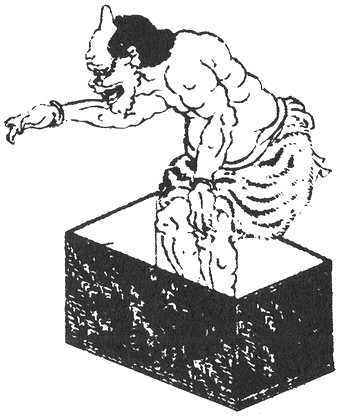
Amanojaku
amanojaku
A small, perverse demon that reads human hearts and does the opposite of what is desired. Famous as the villain of folk tales like Uriko-hime, and depicted in Buddhist sculpture as a creature trampled underfoot by guardian deities.