
Hari-onago
hari-onago
Also known as: hook-hair woman、needle-haired woman
A beautiful woman from Hiroshima folklore whose long hair ends in sharp barbed hooks, which she uses like a whip to snare men who smile back at her.
- Era
- Unknown
- Region
- Chugoku
- Type
- Animal Yokai
Overview
The Hari-onago is a yokai native to the Chūgoku region of western Japan, particularly associated with Hiroshima prefecture. Her name translates roughly to "needle woman" or "hook-hair girl," and she presents as a beautiful young woman walking alone on dark roads at night. Her true nature is hidden in her hair: each strand ends in a sharp, barbed hook, and she can wield this mass of hooked hair like a whip or net. Her method of attack is triggered by a specific social gesture — if a man she encounters smiles back at her, the hair flies out and the hooks sink in.
Appearance
By all surface appearances, the Hari-onago is an ordinary, attractive young woman. Her hair is long and dark, which in traditional Japanese aesthetic is a sign of beauty and femininity. Nothing about her face or manner betrays what she is. It is only when the attack begins — the hair suddenly extending, lashing out, hooks glinting in the moonlight — that her true nature is revealed. The transformation from beautiful stranger to deadly predator is instantaneous and total.
The Danger of Smiling Back
The triggering mechanism of the Hari-onago's attack is unusual and culturally specific. She approaches a lone traveler on a night road and smiles at him. If the man smiles back — a natural, friendly response to a seemingly harmless greeting — the hair erupts outward and the hooks tear into him. The only safe response is to maintain a blank, unsmiling expression and walk away. This creates a trap in which social normalcy is weaponized: the polite, human response kills you, while the cold and unfriendly response saves you.
Symbolic Interpretation
The Hari-onago can be read as an allegory of the dangers of naive attraction — of being drawn in by surface beauty without considering what might lurk beneath. Her hair, traditionally the most visible symbol of feminine beauty in Japan, is literally weaponized. The act of smiling back, of accepting the invitation of an attractive stranger on a dark road, is framed as the fatal mistake. In this sense she belongs to a broader category of dangerous female yokai — including the Yuki-onna and the Jorō-gumo — who lure men to their doom.
Regional Identity
The Hari-onago is distinctly tied to the Chūgoku region, giving her a strong geographic identity compared to the many yokai that are distributed nationally. She was popularized beyond her home region by the yokai artist Mizuki Shigeru, whose illustrated bestiaries brought regional folklore to a national audience in the latter half of the twentieth century.
Sources
- 『Yōkai Dangi』 Kunio Yanagita (1956)
- 『Yōkai Daizen』 Mizuki Shigeru (2004)
Related Yokai
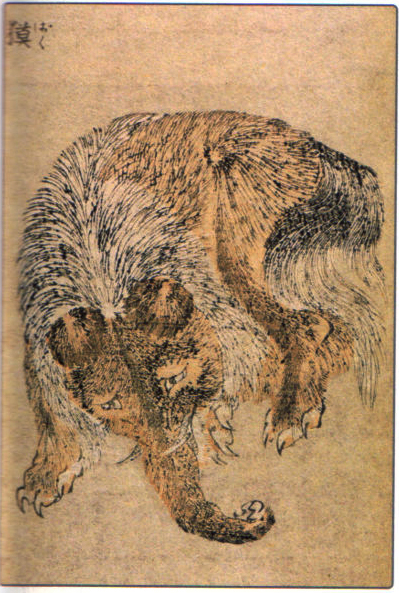
Baku
baku
A chimeric dream-eater invoked after nightmares to consume ill omens.
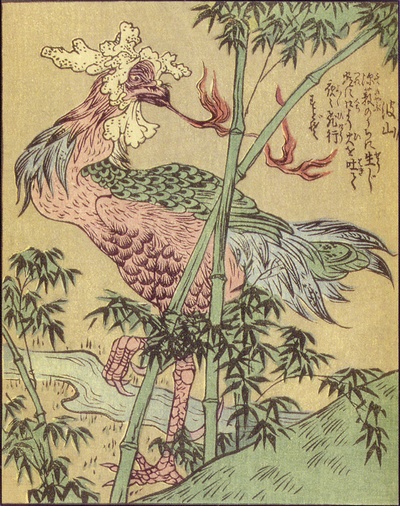
Basan
basan
A fire-breathing rooster yokai from the Kinki and Chūgoku regions of Japan. It appears at night with a distinctive flapping sound, breathes flames, and vanishes before anyone can get a clear look at it.
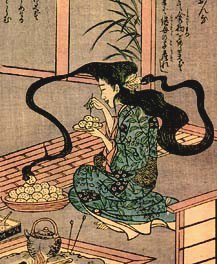
Futa-kuchi-onna
futa-kuchi-onna
A woman with a second mouth on the back of her head that secretly consumes food, with hair that moves like a snake to feed it.