Futa-kuchi-onna
futa-kuchi-onna
Also known as: Two-mouthed woman、double-mouthed woman
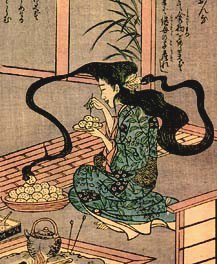
A woman with a second mouth on the back of her head that secretly consumes food, with hair that moves like a snake to feed it.
- Era
- Edo Period
- Region
- Nationwide
- Type
- Animal Yokai
Overview
The Futa-kuchi-onna, literally "two-mouthed woman," is a yokai depicted as an ordinary woman who conceals a terrifying secret: a second mouth located on the back of her head or at the base of her skull. While she appears completely normal in everyday life, the hidden mouth whispers, demands food, and even uses the woman's hair like serpentine tentacles to feed itself when no one is watching. She was most famously depicted by the artist Toriyama Sekien in his illustrated compendium Gazu Hyakki Yagyō (1776).
Appearance
To an outside observer, the Futa-kuchi-onna looks like any ordinary woman. Her face is unremarkable, her manner composed. But on the back of her head, hidden beneath her long dark hair, lies a second mouth — complete with lips, teeth, and a tongue. This hidden mouth can speak, groan, and devour food. Most disturbingly, the woman's long hair acts with independent will, snaking backward to push food into the rear mouth. Sekien's illustration captures this with vivid horror: the back of the head split open in a ravenous grin.
Origins and Folklore
The most widespread legend behind the Futa-kuchi-onna involves a wicked stepmother who starved her stepchild while eating heartily herself. As punishment for her cruelty and greed, a second mouth appeared at the back of her skull — one that could never be satisfied and would eat everything she tried to withhold from others. In another version, a woman who ate excessively in secret was transformed, the hidden mouth serving as a physical manifestation of her concealed gluttony.
Symbolic Meaning
The Futa-kuchi-onna functions as a powerful moral allegory about deception and hidden desire. The doubled mouth literalizes the concept of someone who says one thing while doing another — a person who presents a virtuous face to the world while harboring a secret, ravenous self. The independent hair feeding the rear mouth further emphasizes that concealed desires will act on their own even against the host's will. In Edo-period Japan, where social harmony required carefully managed appearances, such a metaphor carried strong cultural weight.
Cultural Legacy
The Futa-kuchi-onna remains one of the most enduringly popular yokai in modern Japanese horror culture. Her striking visual — a normal woman whose hair reveals a second, devouring mouth — has been adapted in films, manga, and video games. She represents the broader tradition of female yokai in Japanese folklore, where women's hidden emotions, suppressed desires, and social constraints find expression in monstrous form.
Sources
- 『Gazu Hyakki Yagyō』 Toriyama Sekien (1776)
- 『Wakan Sansai Zue』 Terajima Ryōan (1713)
Related Yokai
Abumi-guchi
abumi-guchi
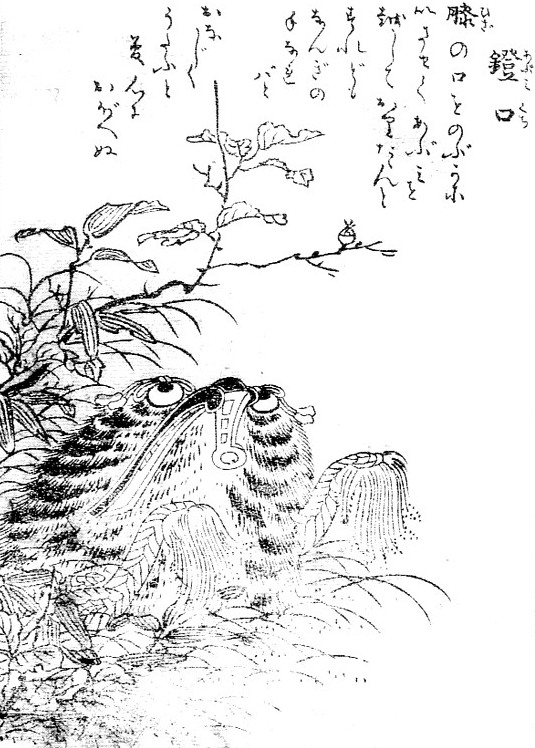
A tsukumogami born from a horse's stirrup abandoned on a battlefield, still waiting for the master who never returned — grief and loyalty made monstrous.
Aka-name
aka-name
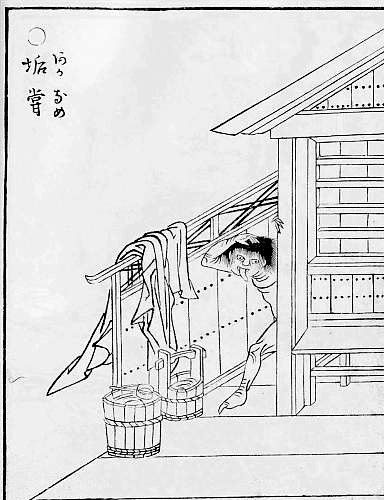
A yokai that visits neglected bathrooms to lick up the accumulated grime and scum — harmless to people, but a vivid supernatural reminder to keep the bath clean.
Amanojaku
amanojaku
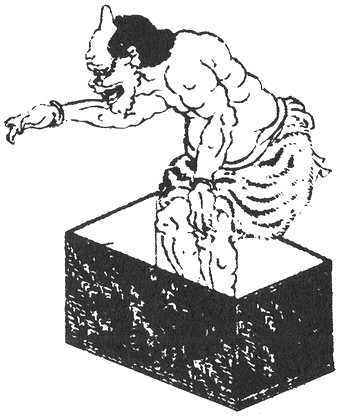
A small, perverse demon that reads human hearts and does the opposite of what is desired. Famous as the villain of folk tales like Uriko-hime, and depicted in Buddhist sculpture as a creature trampled underfoot by guardian deities.