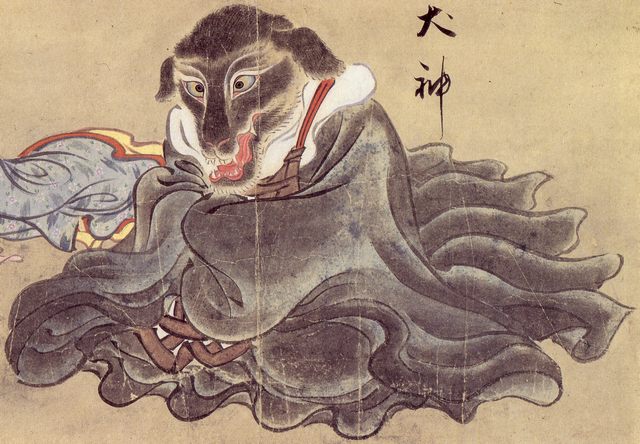
Inugami
inugami
Also known as: Dog God、Dog Spirit
A possessing spirit from Shikoku, Japan. Certain families were believed to control dog spirits that could curse others, leading to deep-rooted social discrimination against so-called "inugami families."
- Era
- Unknown
- Region
- Shikoku
- Type
- Animal Yokai
Overview
The inugami, literally "dog god" or "dog spirit," is a type of possessing spirit deeply embedded in the folk beliefs of Shikoku — the smallest of Japan's four main islands, encompassing present-day Ehime, Kōchi, Tokushima, and Kagawa Prefectures. Alongside the fox spirit (kitsune-tsuki), the inugami represents one of Japan's most culturally significant possession traditions. Unlike many yokai that are encountered randomly in the wild, the inugami is intimately connected to specific human families believed to harbor and control these spirits across generations.
Origin and Nature
The most commonly cited origin story for the inugami involves a particularly cruel ritual: a dog is buried alive up to its neck with food placed just out of reach, and left to die of hunger and thirst. The intense suffering and resentment of the dying animal is said to generate a powerful spirit that can then be controlled by the person who created it. This spirit — the inugami — can be directed against enemies or rivals, causing illness, misfortune, and even death through supernatural possession.
Folklorists including Kunio Yanagita have noted that the actual practice of such rituals is uncertain and likely apocryphal. What is significant is not whether the ritual was performed but how the belief system functioned within communities as a mechanism for social exclusion and fear.
The Inugami Lineage and Social Discrimination
The most distinctive feature of inugami belief is its hereditary nature. Certain families — referred to as "inugami-mochi" (inugami holders) or "inugami-suji" (inugami lineage) — were believed to pass down the ability to control dog spirits from generation to generation. Other villagers often refused to intermarry with such families, fearing that the inugami curse would spread to their own bloodlines.
This belief gave rise to systematic social discrimination against families labeled as inugami-mochi. They were often marginalized within their communities, excluded from social events, and treated as dangerous outsiders despite having no means to prove their innocence. Such discrimination persisted well into the Meiji and Taishō eras (late 19th to early 20th century), and has been documented in regional historical records and ethnographic surveys.
Symptoms and Exorcism
A person possessed by an inugami was said to display a range of disturbing symptoms: sudden mental disturbance, unexplained illness, or making sounds resembling a dog's barking or whimpering. Local shamans, shrine priests, or Buddhist exorcists were consulted to drive out the possessing spirit. Families of the afflicted would often pay for elaborate purification rituals in hopes of relief.
Folkloric Significance
In his landmark work Yōkai Dangi (1956), Kunio Yanagita examined inugami belief as one of the most persistent examples of possession faith in Japan. He highlighted the uniquely hereditary nature of the inugami tradition as distinguishing it from other possessing spirits like foxes or badgers, which tend to attach themselves to individuals rather than family lines. The inugami tradition continues to be an important subject in Japanese folklore studies, both as a window into premodern folk religion and as a historical example of how supernatural belief can be weaponized to justify social prejudice.
Sources
- 『Yōkai Dangi』 Yanagita Kunio (1956)
Related Yokai
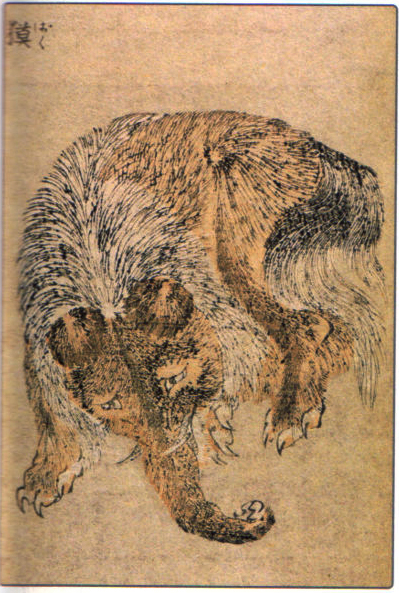
Baku
baku
A chimeric dream-eater invoked after nightmares to consume ill omens.
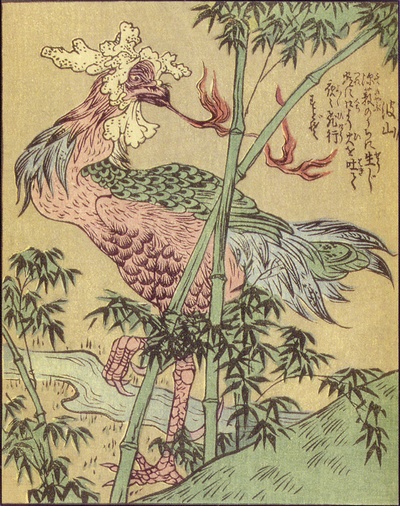
Basan
basan
A fire-breathing rooster yokai from the Kinki and Chūgoku regions of Japan. It appears at night with a distinctive flapping sound, breathes flames, and vanishes before anyone can get a clear look at it.
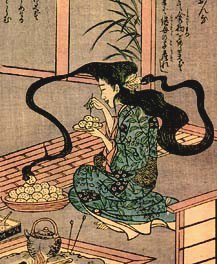
Futa-kuchi-onna
futa-kuchi-onna
A woman with a second mouth on the back of her head that secretly consumes food, with hair that moves like a snake to feed it.