Overview
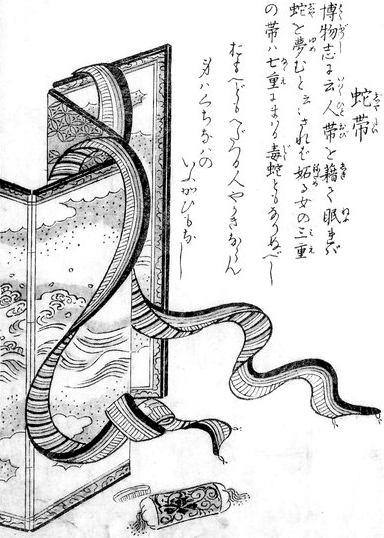
The jatai is a tsukumogami — an object possessed by a spirit — formed when an old obi sash used by a woman transforms into a serpent. It was depicted by Toriyama Sekien in his collection Hyakki Tsurezurebukuro (1784), the final volume of his celebrated yokai encyclopedia series. The transformation of an obi into a snake brings together two of the most potent symbols in Japanese supernatural tradition: the tsukumogami belief that old objects develop souls, and the deep cultural association between serpents and obsessive female emotion — jealousy, longing, and the refusal to let go.
Appearance
In Sekien's illustration, the jatai appears as an obi sash whose form has partially transformed — the fine fabric and intricate pattern of a traditional obi is visible, but it has begun to move with sinuous, serpentine life. The sash coils upon itself, and at one end a serpent's head has emerged, its expression conveying the cold, focused attention of a snake that has identified its prey. The combination of beautiful textile craft and the predatory geometry of a snake is one of the more aesthetically striking contrasts in Sekien's work.
The Obi and Women's Culture
The obi is one of the most significant garments in traditional Japanese dress — a wide sash wound around the body above a kimono, tied in elaborate knots at the back, close to the body for hours of each day. Unlike outer garments, the obi is intimate, requiring skill to tie and representing a significant investment of time and care. High-quality obi were precious objects passed between generations of women, accumulating years of wear and the sweat and emotions of their owners. Such an object, under the tsukumogami doctrine that long-used items develop supernatural awareness, would naturally become imbued with the accumulated emotional residue of all the women who had worn it.
The Serpent Symbolism
In Japanese tradition, serpents are strongly associated with the intensity of female emotion, particularly jealousy and obsessive love. The nure-onna (wet woman) and uwabami (giant serpent) of Japanese legend connect women who harbor intense, unresolved emotions with serpentine transformation. The jatai embodies this connection: an object that has been worn through times of joy and grief, longing and jealousy, could accumulate enough emotional resonance to become literally snake-like in its animating principle.
Cultural Significance
The jatai represents the intersection of Japanese material culture, tsukumogami belief, and gender mythology. It reminds us that in traditional Japanese supernatural thought, objects were not neutral — they absorbed the lives of those who used them and could, under the right conditions, reflect those lives back in transformed and dangerous form. In modern Japanese media, the jatai appears in tsukumogami-themed games and fiction as one of the more elegant and melancholy examples of the category.