
Koro-Pok-Guru
koro-pok-guru
Also known as: Koropokkuru、people under the butterbur leaves
Small people from Ainu tradition who live beneath butterbur leaves and gift fish to humans. Their name means "people under the fuki plant."
- Era
- Ancient
- Region
- Hokkaido
- Type
- Mountain Yokai
Overview
The koro-pok-guru are small people from the oral tradition of the Ainu, the indigenous people of Hokkaido and surrounding regions. Their name in the Ainu language means "people under the koro (fuki / butterbur) leaves" — they are said to make their homes beneath the enormous leaves of the Japanese butterbur plant (Petasites japonicus), which can grow large enough to shelter a small person from rain.
Small in stature but immensely skilled as fishers, the koro-pok-guru are remembered above all for their gifts: they would leave fish at Ainu dwellings during the night, slipping the offering through a small window or hole and vanishing before they could be seen.
The Legend of Their Departure
For generations the koro-pok-guru and the Ainu coexisted peacefully. The koro-pok-guru valued their privacy intensely and always came under cover of darkness. Then, according to the most widely known tradition, a young Ainu man grew impatient to see what one of these small visitors actually looked like. He grabbed the wrist of a koro-pok-guru woman as she made her delivery and pulled her into view.
Outraged at this violation, the koro-pok-guru left and never returned. The gifts of fish ceased. The story encodes a moral about gratitude and restraint: the unseen benefactor, taken for granted and finally grabbed at, is lost forever.
Academic Controversy
In the late nineteenth and early twentieth centuries, the koro-pok-guru became the subject of a famous scholarly debate between Japanese anthropologists Tsuboi Shogoro and Torii Ryuzo. Tsuboi argued that the koro-pok-guru were folk memories of a pre-Ainu people who had inhabited Hokkaido — possibly ancestral to the Jōmon. Torii disputed this, attributing the tradition to Ainu mythology rather than historical memory. The debate (known as the "Koropokkuru Controversy") was one of the foundational discussions of early Japanese anthropology.
Legacy
Today the koro-pok-guru are beloved in Hokkaido popular culture, appearing in craft traditions, local tourism, and fiction. Their image — tiny, nimble, generous, and shy — makes them one of the most appealing figures in northern Japanese supernatural lore. Chiri Yukie's Ainu Shin'yoshu (1923), a landmark collection of Ainu oral literature compiled by a young Ainu woman, preserves the tradition in its most authoritative written form.
Sources
- 『Ainu Shin'yoshu』 Chiri Yukie (1923)
Related Yokai
Azuki-Babaa
azuki-babaa
A dangerous old-woman yokai who scrapes azuki beans in mountain streams. Related to the azuki-arai but more specifically formed and more actively threatening.
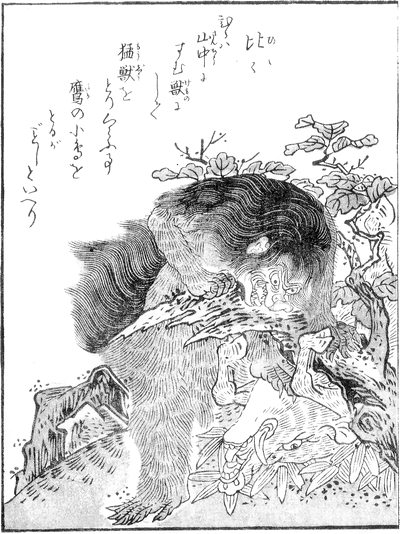
Hihi
hihi
A gigantic ape-like mountain demon known for abducting villagers. Despite its fearsome strength, it has a notorious weakness for sake, and many folk tales describe heroes using alcohol to defeat it.
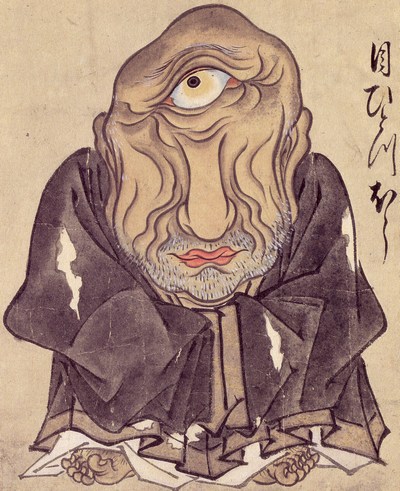
Hitotsume-nyudo
hitotsume-nyudo
A giant monk-shaped yokai with a single enormous eye in the center of its face, which appears on mountain roads and night paths. The hitotsume-nyudo combines the cyclops archetype with Japan's tradition of supernatural "nyudo" priest spirits.