Overview
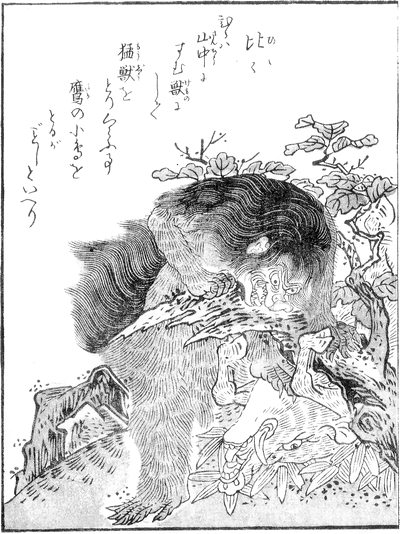
The hihi is a massive, hairy, ape-like demon said to inhabit Japan's deep mountains. It towers over humans, possesses extraordinary physical strength, and is known in folklore for raiding villages to abduct young women. Despite its terrifying power, the hihi has a decisive weakness: it cannot resist sake, and numerous folk tales across Japan describe clever heroes defeating the creature by getting it drunk. The hihi appears in Toriyama Sekien's Gazu Hyakki Yagyō (1776), depicted as a large, elderly-looking figure covered in white-tinged hair — a mountain spirit that has grown old and monstrous in the depths of the wilderness.
Appearance
The hihi is described as a giant primate-like being, sometimes reaching two to three meters in height, with a body covered in coarse hair. Its face resembles both an old man and a monkey. Sekien's canonical illustration emphasizes the creature's aged, patriarch-like quality: white-streaked fur, a weathered face, and an imposing presence that suggests not just brute strength but also an ancient, malevolent intelligence.
The name "hihi" shares its written characters with the real-world baboon (genus Papio), though the Japanese mythological hihi bears no close relationship to the African animal. The shared name reflects the way Edo-period scholars applied existing Chinese and Japanese character compounds to categorize and explain unfamiliar creatures.
Chinese Origins
The hihi appears in Chinese classical texts including the Shanhaijing (Classic of Mountains and Seas) and the Bencao Gangmu, where it is described as a primate-like beast that mimics human voices and behavior — luring travelers with familiar sounds — and is especially notorious for abducting human women. This Chinese tradition traveled to Japan alongside Buddhist and Taoist texts, where it merged with indigenous Japanese beliefs about mountain-dwelling giant men (yamotoko, yamaotoko) to produce the familiar Japanese hihi.
The Sake Weakness
The hihi's vulnerability to alcohol is its most celebrated and widely distributed characteristic. A standard narrative pattern in Japanese folklore runs roughly as follows: a village has been terrorized by a hihi that regularly abducts young women to serve as its wives. A brave young woman (or occasionally man) volunteers to be taken by the creature, knowing that it loves sake. Once in the demon's lair, the captive gradually gains the hihi's trust and begins feeding it large quantities of sake. When the hihi is thoroughly drunk and incapacitated, the hero kills it or escapes. This tale type appears in regional legend collections from across Japan, with local variations in the details.
The sake-weakness motif can be read as a cultural commentary: even the most powerful natural force — represented by the hihi's raw mountain strength — can be undone by human civilization's refinements. Sake, as a product of human craft and agriculture, defeats what brute force cannot.
Relationship to Mountain Giant Traditions
The hihi overlaps with a broader Japanese tradition of giant hairy mountain beings, including the yamotoko (mountain boy/man) and various regional "big man" legends. Some researchers have speculated that these traditions might preserve folk memories of ancient megafauna or pre-modern sightings of bears misidentified as bipedal giants, but the scholarly consensus treats them as cultural constructs expressing the fear and awe of the untamed mountain interior.