
Kuchisake-Onna
kuchisake-onna
Also known as: slit-mouthed woman
A masked woman who asks passersby "Am I pretty?" and reveals a mouth slit to the ears. A modern urban legend that swept Japan in the late 1970s.
- Era
- Unknown
- Region
- Nationwide
- Type
- Road Yokai
Overview
The kuchisake-onna ("slit-mouthed woman") is Japan's most famous modern urban legend — a figure born not in ancient oral tradition but in the late 1970s, yet spreading with the speed and intensity of any traditional supernatural belief.
She appears as a young woman wearing a surgical mask, which was common enough in Japan not to seem alarming. She approaches lone walkers, especially children, and asks: "Am I pretty?" (Watashi, kirei?). If you say yes, she removes the mask, revealing a mouth that has been slit from ear to ear. She asks again: "Even like this?" There is no good answer.
The Spread of the Legend
The kuchisake-onna erupted in Gifu Prefecture in 1978–1979 and spread across Japan with astonishing speed, reaching every corner of the country within months — without the internet, without social media, through word of mouth alone. Schools in some regions arranged supervised group walks home. Police reportedly received reports of sightings. The legend's velocity of transmission became a subject of academic study in its own right.
Survival Strategies
Part of the legend's richness lies in the survival tips that circulated alongside it. Saying "pomade" (pomādo) three times would cause her to hesitate long enough to escape. Offering her hard candy would occupy her while you ran. Answering "you're average" would confuse her. Each community developed its own canon of countermeasures, passed along with the same earnestness as the warning itself.
Connection to Classical Tradition
The slit-mouthed woman did not arise in a vacuum. Japanese classical art and legend feature onibaba (demon women) with supernaturally large mouths, and the theme of a beautiful woman concealing a monstrous truth beneath a gracious appearance runs throughout Japanese ghost story tradition. The kuchisake-onna updated these ancient anxieties in a modern frame: the surgical mask, the urban street, the stranger who asks about beauty.
Legacy
The kuchisake-onna has been adapted into numerous films, manga, and video games and is known internationally under her Japanese name. She remains one of the most studied examples of modern oral tradition — a case study in how fear travels, how communities share danger, and how very old narrative templates can reemerge wearing contemporary clothes.
Sources
- 『Yōkai Dangi』 Kunio Yanagita (1956)
Related Yokai
Abura-Sumashi
abura-sumashi
A straw-cloaked figure on a Kumamoto pass who declares his ancestor haunted it.
Betobeto-San
betobeto-san
An invisible yokai that follows travelers on dark roads, heard only as footsteps behind them. Saying "go ahead of me" makes it disappear.
Hitotsume-kozō
hitotsume-kozo
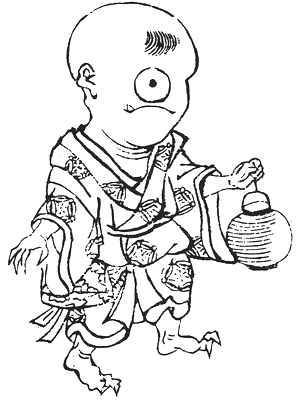
A child-monk yokai with a single large eye in the center of its face, associated with certain calendar days and known to fear objects with many holes.