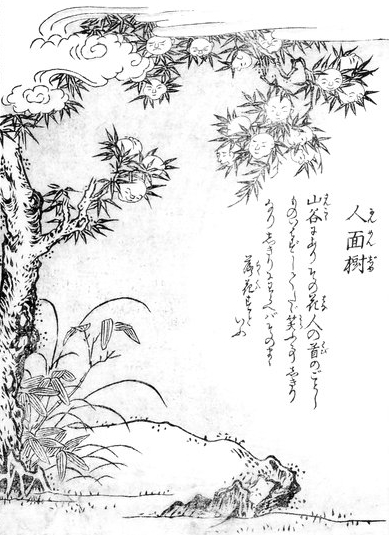
Ninmenju
ninmenju
Also known as: Human-Face Tree、Face Tree
A tree that grows human faces on its trunk and branches. The faces laugh, cry, and sometimes scream — and anyone who hears the tree laugh is said to die.
- Era
- Unknown
- Region
- Nationwide
- Type
- Mountain Yokai
Overview
The ninmenju — "human face tree" — is one of the most disturbing entities in Japanese supernatural tradition: a tree whose trunk and branches are covered with the faces of human beings. The faces emerge from the bark as fully formed features — eyes, noses, mouths — and are capable of expression and, in some accounts, sound. They laugh when the sun rises, weep in rain, and cry out when touched. The ninmenju grows only in remote mountain locations, far from human habitation, and encountering one is considered extremely inauspicious.
Description
The ninmenju is described in encyclopedic texts as an ordinary-looking tree until one looks closely at its bark and realizes that the texture is wrong — that what appeared to be natural grain is actually skin, that the knots in the wood are closed eyes, and that those eyes can open. The faces may number in the dozens or hundreds, packed closely together across the entire surface of the trunk and along each branch. Some descriptions note that the faces appear to be conscious and aware of being observed, their expressions shifting as the tree is approached.
The fruit of the ninmenju, if it has fruit, is described as resembling a human head — smaller than a real head, but unmistakably anthropomorphic. This fruit is either impossible to eat (causing illness or death) or, paradoxically, possessed of miraculous properties in some variant accounts.
Origins and Parallels
The ninmenju has documented parallels in Chinese natural history texts, where similar human-faced plants appear in catalogs of strange phenomena from distant lands. Japan's version was recorded in Wakan Sansai Zue (1713), which drew heavily on Chinese encyclopedic traditions. The concept of plants that bear human features appears across many cultures — the mandrake of European tradition, the barnacle goose plants of medieval imagination — suggesting a widespread human tendency to find the boundary between plant and person deeply uncanny.
The association of the ninmenju with remote mountains connects it to the broader Japanese tradition of the mountain as a space outside normal human rules, where strange transformations are possible and the categories of living things break down. Ancient trees in such locations were already considered spiritually potent; a tree that bore human faces would represent an extreme version of this animistic belief.
Cultural Legacy
The ninmenju appears in modern Japanese horror and fantasy media as an archetype of botanical horror. Its image — a tree studded with laughing and weeping human faces — has proven persistently disturbing across generations and has influenced how botanical horror is portrayed in contemporary visual media from manga to video games. The specific detail that hearing the ninmenju laugh brings death remains one of the most haunting elements of the Japanese supernatural imagination.
Sources
- 『Wakan Sansai Zue』 Terajima Ryoan (1713)
Related Yokai

Azuki-Babaa
azuki-babaa
A dangerous old-woman yokai who scrapes azuki beans in mountain streams. Related to the azuki-arai but more specifically formed and more actively threatening.
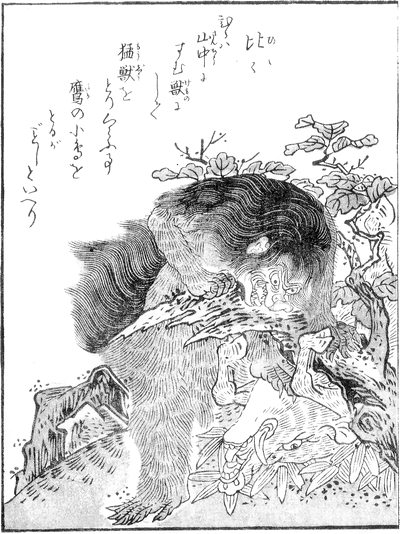
Hihi
hihi
A gigantic ape-like mountain demon known for abducting villagers. Despite its fearsome strength, it has a notorious weakness for sake, and many folk tales describe heroes using alcohol to defeat it.
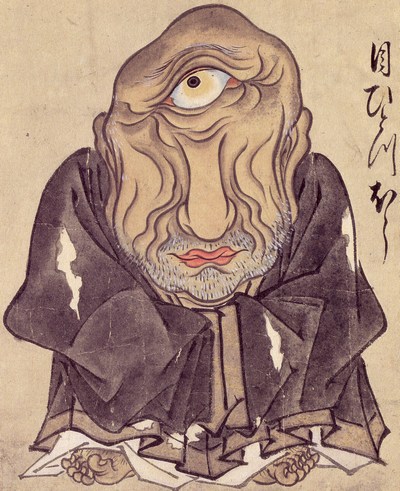
Hitotsume-nyudo
hitotsume-nyudo
A giant monk-shaped yokai with a single enormous eye in the center of its face, which appears on mountain roads and night paths. The hitotsume-nyudo combines the cyclops archetype with Japan's tradition of supernatural "nyudo" priest spirits.