Overview
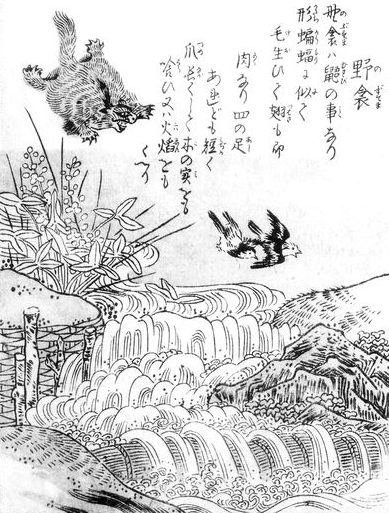
The nobusuma is a yokai formed when a musasabi — the Japanese giant flying squirrel (Petaurista leucogenys) — lives long enough in an ancient mountain tree to accumulate supernatural power and transform into something monstrous. Toriyama Sekien included it in his Gazu Hyakki Yagyō (1776), depicting it with wings dramatically spread. The nobusuma's method of attack is distinctive and deeply unsettling: it descends silently from the darkness above, envelops its victim entirely in its wide membrane — like a living blanket falling from the sky — and suffocates them. The name "nobusuma" is thought to derive from "nobe no fusuma," meaning "the bedcover of the wild," evoking exactly this image of a creature that wraps itself around its prey.
Appearance
The nobusuma resembles an enormously enlarged flying squirrel, its patagium — the skin membrane stretching between its limbs — wide enough to engulf a full-grown human. In Sekien's illustration, the creature is shown with wings outstretched in a posture that clearly evokes the act of smothering something beneath it. Its eyes are large and reflective, adapted for night vision, and its overall form is that of a musasabi magnified and made terrible by years of supernatural accumulation.
The creature is nocturnal, descending silently on mountain travelers and woodcutters from the tree canopy above. The victim finds themselves suddenly wrapped in the nobusuma's membrane, unable to move their arms, and progressively unable to breathe as the creature tightens its grip.
The Flying Squirrel's Eerie Nature
The Japanese giant flying squirrel is a genuinely impressive animal — capable of gliding up to 160 meters between trees using its broad patagium — and its nighttime appearances in mountain forests must have been striking to premodern observers. A large shadow suddenly launching from a high tree and sailing silently through the dark air toward you would be alarming even today. The folk belief that such a creature, given enough age and spiritual accumulation, could become a predatory yokai reflects a consistent pattern in Japanese supernatural thought: long-lived animals cross the boundary between the natural and supernatural.
Regional Tradition
Nobusuma traditions are most densely concentrated in the mountainous regions of the Chubu area — modern Nagano, Gifu, and Aichi Prefectures — which happen to be prime habitat for the actual Japanese giant flying squirrel. Woodcutters and yamabushi (mountain ascetics) who spent nights in the forest would have been most likely to encounter flying squirrels and to generate the stories that eventually crystallized as the nobusuma tradition.
Cultural Notes
The nobusuma is one of the less widely known yokai outside of specialist circles, lacking the cultural ubiquity of the kappa or tengu. However, its distinctive attack mode — airborne ambush, physical enveloping, suffocation — has influenced the design of aerial monster encounters in modern fantasy games and anime, where creatures that smother or engulf victims from above are a recognized archetype. Sekien's canonical illustration remains the primary visual reference for this yokai.