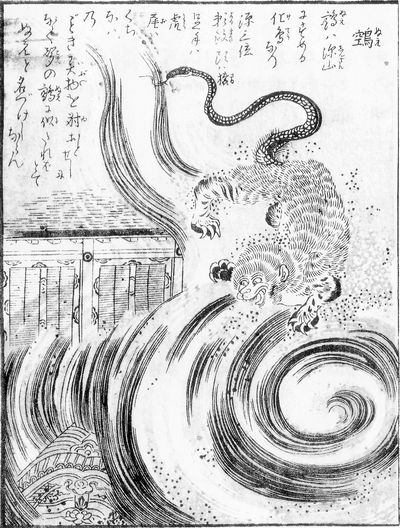
Nue
nue
Also known as: chimera
A chimera with a monkey head, tanuki body, and serpent tail, slain in Heike.
- Era
- Heian Period
- Region
- Kinki
- Type
- Animal Yokai
Overview
The nue is a composite monster: the head of a monkey, the body of a tanuki (raccoon dog), the tail of a serpent, and the limbs of a tiger. Its cry resembles that of a White's thrush (Zoothera aurea) — an eerie, fluting call that gives it an alternative name in some texts. The nue stands among Japan's oldest documented yokai, named in texts from the Heian period (794–1185).
The Tale of the Heike
The most famous nue legend appears in The Tale of the Heike, the great medieval war chronicle. Emperor Konoe fell mysteriously and gravely ill, and each night a black cloud gathered over the imperial palace. The warrior Minamoto no Yorimasa was summoned and fired an arrow into the cloud. A creature fell — the nue — and was finished off with a dagger by Yorimasa's attendant. The emperor recovered. Yorimasa was awarded the prized sword Shishi-Ō ("Lion King") for the feat. The nue's body was placed in a boat and cast adrift on the river.
"Nue-Like" as a Concept
The word nue-teki ("nue-like") entered Japanese as an adjective for anything that is uncategorizable, ambiguous, or impossible to pin down. A politician who is hard to read, an artistic movement that defies genre, a scandal that resists simple explanation — all may be called nue-teki. The chimeric yokai became a metaphor for the fundamentally unclassifiable.
In Later Culture
The nue appears as the protagonist of a Noh play in which Yorimasa's victim, unable to rest, narrates its own story. Toriyama Sekien illustrated it in his encyclopedias, and it remains a staple of modern games and anime as the archetypal composite monster.
Sources
- 『The Tale of the Heike』 Unknown (1243)
- 『Gazu Hyakki Yagyō』 Toriyama Sekien (1776)
Related Yokai
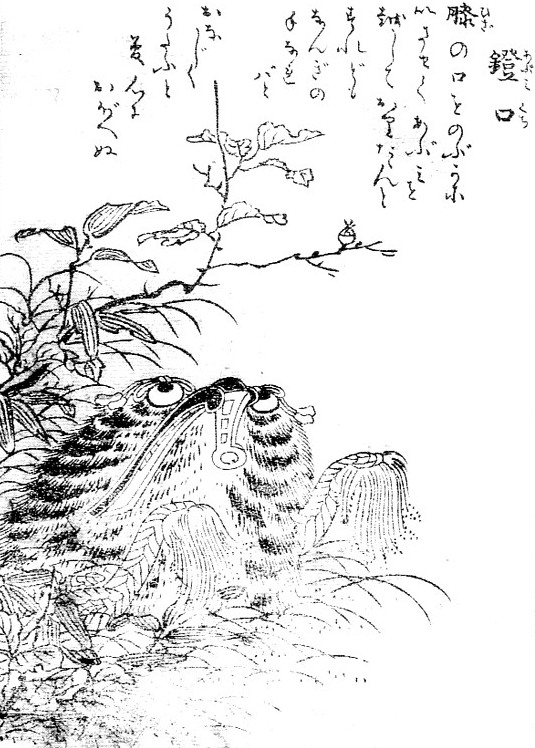
Abumi-guchi
abumi-guchi
A tsukumogami born from a horse's stirrup abandoned on a battlefield, still waiting for the master who never returned — grief and loyalty made monstrous.
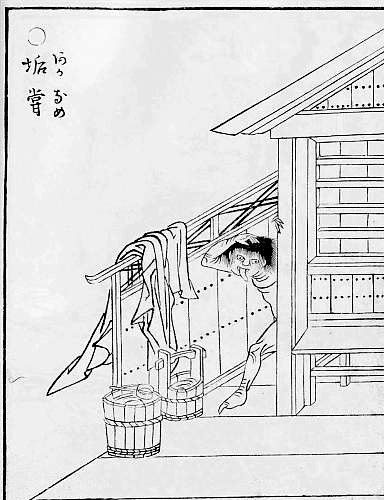
Aka-name
aka-name
A yokai that visits neglected bathrooms to lick up the accumulated grime and scum — harmless to people, but a vivid supernatural reminder to keep the bath clean.
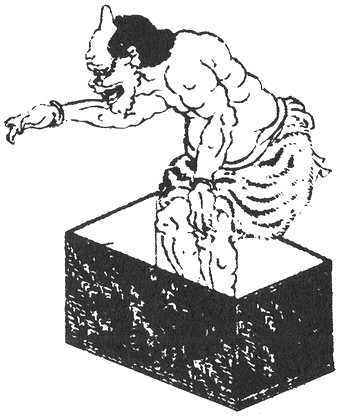
Amanojaku
amanojaku
A small, perverse demon that reads human hearts and does the opposite of what is desired. Famous as the villain of folk tales like Uriko-hime, and depicted in Buddhist sculpture as a creature trampled underfoot by guardian deities.