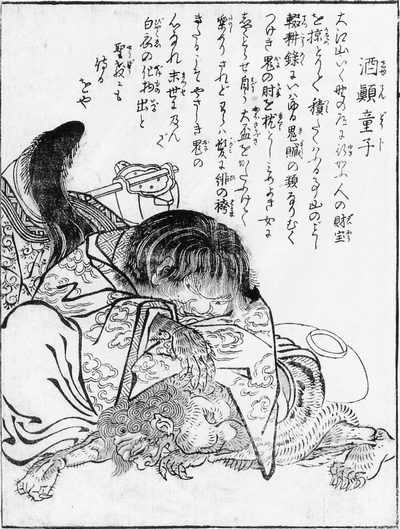
Shuten-doji
shuten-doji
Also known as: Drunken Demon、Lord of Oni
The most fearsome oni lord of Japanese legend, who ruled Mount Oeyama with an army of demons. Shuten-doji was renowned for his great size, supernatural strength, and love of sake — and was ultimately slain by the hero Minamoto no Yorimitsu.
- Era
- Heian Period
- Region
- Kinki
- Type
- Oni、Mountain Yokai
Overview
Shuten-doji is the supreme demon lord of Japanese mythology, a towering oni who established a stronghold on Mount Oeyama (in present-day Kyoto Prefecture) and terrorized the imperial capital during the Heian period. His name means "drunken boy" or "sake-drinking child," reflecting his legendary appetite for alcohol. He commanded a vast army of oni and regularly sent his demons to abduct young noblewomen from Kyoto, carrying them back to his mountain fortress. He is ultimately defeated by the hero Minamoto no Yorimitsu (Raiko) and his legendary band of retainers, making his story one of Japan's defining tales of heroic monster-slaying.
Appearance and Power
Shuten-doji is described as enormous — accounts vary, but he is depicted as many times the size of an ordinary human. His face is described as demonic in the extreme: five horns on his head, fifteen eyes, and wild red hair in some of the most elaborate descriptions. He drinks sake from a massive cup the size of a bathtub. Despite his terrifying appearance, his conversation is said to be surprisingly sophisticated; in some versions of the legend, he engages the disguised heroes in philosophical discussion before the attack, unaware that they are planning to kill him.
The Legend of Yorimitsu
The story of Shuten-doji's downfall is one of Japan's most celebrated hero tales. Minamoto no Yorimitsu and his companions — including the warrior Watanabe no Tsuna — disguised themselves as yamabushi (mountain ascetics) and traveled to Oeyama. They were welcomed into the demon's fortress and given a feast of sake that had been specially prepared for the purpose: it was a supernatural draught given to Yorimitsu by deities to weaken oni. Shuten-doji, who prided himself on being able to drink anything, drank deeply and fell into a stupor. Yorimitsu then produced the divine sword Doujikiri and beheaded the demon lord. Even in death, Shuten-doji's severed head attempted to continue fighting, biting at Yorimitsu's helmet before the spirit finally dissipated.
Cultural Significance
Shuten-doji has become one of the defining figures of Japanese demonology and is frequently depicted in art from the Heian period through the present day. Illustrated scrolls (emakimono) depicting the Oeyama battle are among the masterpieces of Japanese medieval painting. The story encodes important cultural values: the power of righteous heroes backed by divine support, the vulnerability of even the strongest demon to cunning and spiritual preparation, and the danger of pride — Shuten-doji's greatest weakness was his certainty of his own invincibility.
Sources
- 『Oeyama Ekotoba』 Unknown (1400)
- 『Konjaku Monogatarishu』 Unknown (1120)
Related Yokai
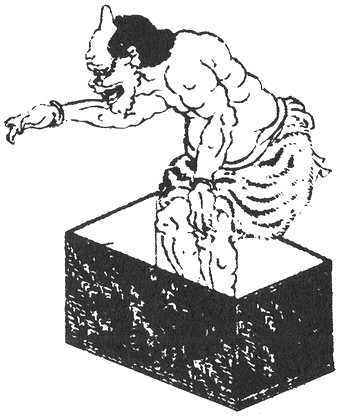
Amanojaku
amanojaku
A small, perverse demon that reads human hearts and does the opposite of what is desired. Famous as the villain of folk tales like Uriko-hime, and depicted in Buddhist sculpture as a creature trampled underfoot by guardian deities.

Azuki-Babaa
azuki-babaa
A dangerous old-woman yokai who scrapes azuki beans in mountain streams. Related to the azuki-arai but more specifically formed and more actively threatening.
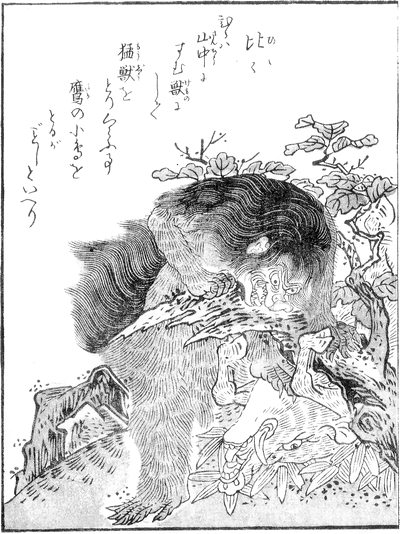
Hihi
hihi
A gigantic ape-like mountain demon known for abducting villagers. Despite its fearsome strength, it has a notorious weakness for sake, and many folk tales describe heroes using alcohol to defeat it.