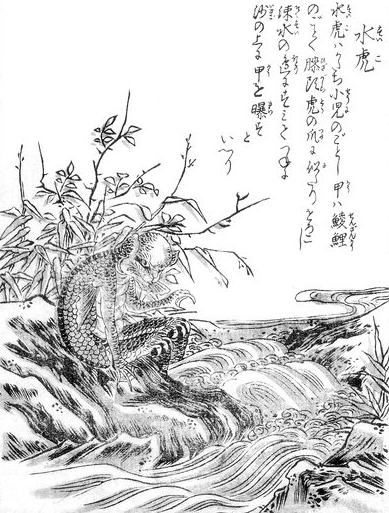
Suiko
suiko
Also known as: Water Tiger、River Tiger
A ferocious water demon with tiger-like strength inhabiting rivers and ponds across Japan. Derived partly from Chinese natural lore, it is often conflated with the kappa but is considered more dangerous and purely predatory.
- Era
- Heian Period
- Region
- Nationwide
- Type
- Water Yokai、Animal Yokai
Overview
The suiko — "water tiger" — is a ferocious aquatic creature said to inhabit rivers, lakes, and ponds throughout Japan. Where the kappa is often depicted as mischievous and sometimes friendly, the suiko is portrayed as purely predatory: a water beast with the strength and aggression of a tiger, which drags humans and animals into the water to kill and consume them. The suiko has deep roots in Chinese natural philosophy and reached Japan as part of the broader transmission of continental knowledge, eventually intertwining with native Japanese water spirit beliefs in complex ways.
Appearance
Descriptions of the suiko vary across sources, but the Wakan Sansai Zue encyclopedia (1713) by Terajima Ryōan provides one of the most detailed Japanese accounts. It describes the suiko as resembling a large monkey with tiger-like stripes, a carapace on its back, and extremely sharp claws. The shell connects it visually to the kappa (which also bears a carapace), but the suiko is larger, more muscular, and more overtly dangerous. Its claws are strong enough to tear through flesh, and its grip on a victim dragged underwater is said to be impossible to break.
Chinese Origins
The suiko appears in several Chinese classical texts, including the Baopuzi and the Bencao Gangmu (Compendium of Materia Medica). In these sources, it is described as a dangerous river creature resembling a cross between a monkey and a tiger, lurking beneath the surface of rivers and attacking anyone who wades or swims. When this concept traveled to Japan, it encountered and partially merged with the existing kappa tradition, resulting in the suiko being treated sometimes as a distinct creature and sometimes as a more powerful variant of the kappa.
Suiko versus Kappa
Although the suiko and kappa are often conflated in popular understanding, they retain distinct identities in the folk tradition. The kappa is fundamentally ambivalent — it can be dangerous but also playful, cunning, and occasionally helpful. It can be tricked, bargained with, or even befriended. The suiko, by contrast, has almost no positive or comedic dimension in the surviving accounts. It exists purely to prey on the unwary, and tales of humans successfully outwitting or befriending a suiko are rare or absent.
In terms of appearance, the kappa is generally child-sized and somewhat humanoid, while the suiko's tiger-like characteristics and larger scale make it more overtly beast-like and threatening.
The Suiko as Embodiment of River Danger
Like the kappa, the suiko can be understood as a concrete embodiment of the very real dangers posed by rivers and lakes in pre-modern Japan. Drowning was among the most common causes of accidental death, and the concept of a powerful predatory creature living beneath the water's surface provided a vivid explanation for unexpected drownings. Warning children to stay away from rivers by invoking the suiko served a practical safety function alongside its supernatural dimension.
Distribution and Records
Suiko traditions are found nationwide, with particularly strong accounts associated with large bodies of water such as Lake Biwa and the Tone River basin. Edo-period natural historians and encyclopedists regularly addressed the relationship between the suiko and the kappa, treating it as a question of taxonomic classification within a broader system of aquatic supernatural creatures. This quasi-scientific engagement with yokai taxonomy reflects the intellectual culture of the Edo period, where natural history and folk belief were not yet sharply distinguished.
Sources
- 『Wakan Sansai Zue』 Terajima Ryōan (1713)
Related Yokai
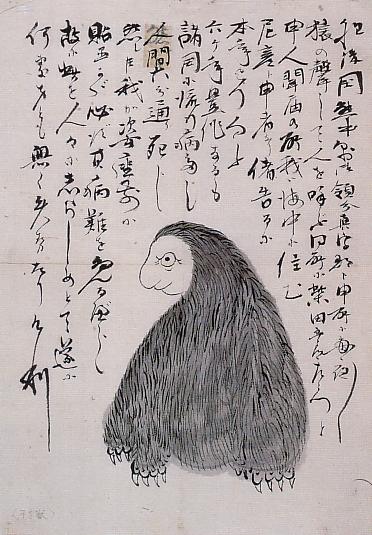
Amabie
amabie
An 1846 sea spirit that foretold plague, asking its image be shown to the sick.
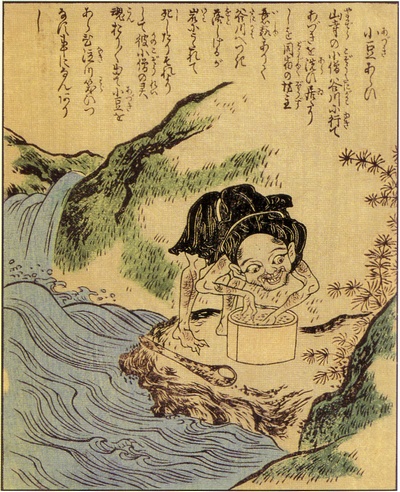
Azuki-Arai
azuki-arai
A yokai heard but rarely seen, washing azuki beans by a riverbank at night.

Azuki-Babaa
azuki-babaa
A dangerous old-woman yokai who scrapes azuki beans in mountain streams. Related to the azuki-arai but more specifically formed and more actively threatening.