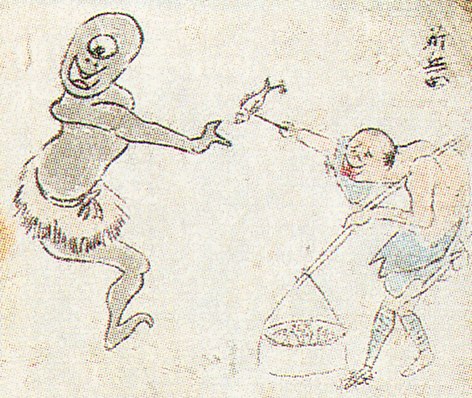
Yamajijii
yamajijii
Also known as: mountain old man、mountain grandfather
A one-eyed, one-legged old man who dwells in deep mountain wilderness, encountered by hunters and woodcutters and sometimes understood as a manifestation of the mountain deity itself.
- Era
- Unknown
- Region
- Nationwide
- Type
- Mountain Yokai
Overview
The Yamajijii ("mountain old man" or "mountain grandfather") is a yokai of the deep mountains found in traditions across Japan. It appears as an elderly man — white-haired, weathered, sometimes massive in stature — but with two immediately striking abnormalities: a single eye in the center of its face and a single leg to stand on. These traits identify it as unmistakably non-human, a being of the mountain world rather than the human world. Despite its potentially alarming appearance, the Yamajijii is not consistently aggressive; some accounts describe it as answering questions, responding to calls, or simply standing and watching.
Appearance
The Yamajijii presents as a very old, very large man of the mountains. His skin is weathered, his hair is white, and he may be clothed in rough mountain garb or barely clothed at all. His single eye — situated in the center of his face where two eyes would normally be — gives him an intense, unblinking focus. He stands on one leg with perfect steadiness. Some accounts give him an enormous voice that carries across valleys; others describe him as moving in absolute silence despite the rocky terrain.
Mountain Deities and Asymmetry
The one-eyed, one-legged form of the Yamajijii is shared with many mountain spirits in Japanese folklore — a cluster of figures that Kunio Yanagita identified as related to the concept of the marebito, a visiting divine being from outside the human world. Single-eyedness and single-leggedness are markers of radical difference from humans, who are defined by bilateral symmetry. A creature with half the normal number of a defining feature is placed at a strange boundary: less than human, or perhaps more? The asymmetry may also reflect the mountain environment itself, which is tilted, uneven, and does not offer the flat surfaces of human habitation.
Behavior Toward Humans
Encounters with the Yamajijii in folk accounts vary considerably. Hunters who enter the deep mountains for the first time may encounter it, and their response determines the outcome. A traveler who shows respect — bowing, not staring, speaking politely — may receive a response or simply be allowed to pass. One who acts with arrogance or contempt may be injured or lost. Some traditions hold that the Yamajijii will answer any question asked of it, like an oracle of the mountain; others say it echoes words back, connecting it to the yamabiko (mountain echo) tradition.
Relationship to Mountain Religion
The Yamajijii intersects with Japan's long tradition of mountain asceticism (shugendō) and the belief that mountains are the dwelling places of powerful gods. Practitioners who spent years in mountain retreats were said to develop extraordinary abilities, and the Yamajijii may in some traditions represent such a practitioner who has been in the mountains so long that he has become part of them — neither fully human nor fully divine.
Sources
- 『Konjaku Hyakki Shūi』 Toriyama Sekien (1781)
- 『Yōkai Dangi』 Kunio Yanagita (1956)
Related Yokai

Azuki-Babaa
azuki-babaa
A dangerous old-woman yokai who scrapes azuki beans in mountain streams. Related to the azuki-arai but more specifically formed and more actively threatening.
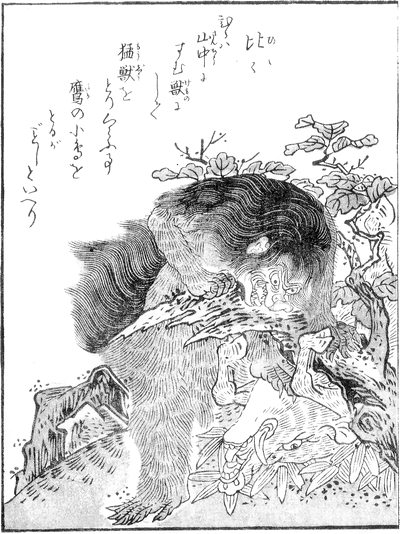
Hihi
hihi
A gigantic ape-like mountain demon known for abducting villagers. Despite its fearsome strength, it has a notorious weakness for sake, and many folk tales describe heroes using alcohol to defeat it.
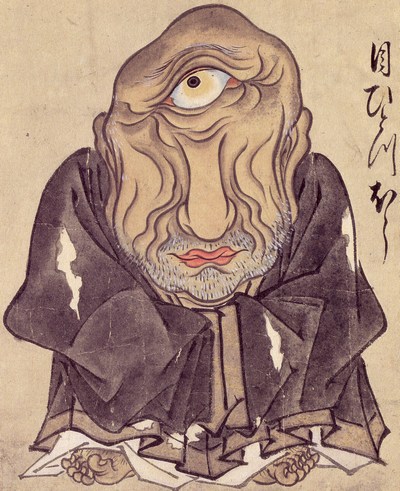
Hitotsume-nyudo
hitotsume-nyudo
A giant monk-shaped yokai with a single enormous eye in the center of its face, which appears on mountain roads and night paths. The hitotsume-nyudo combines the cyclops archetype with Japan's tradition of supernatural "nyudo" priest spirits.