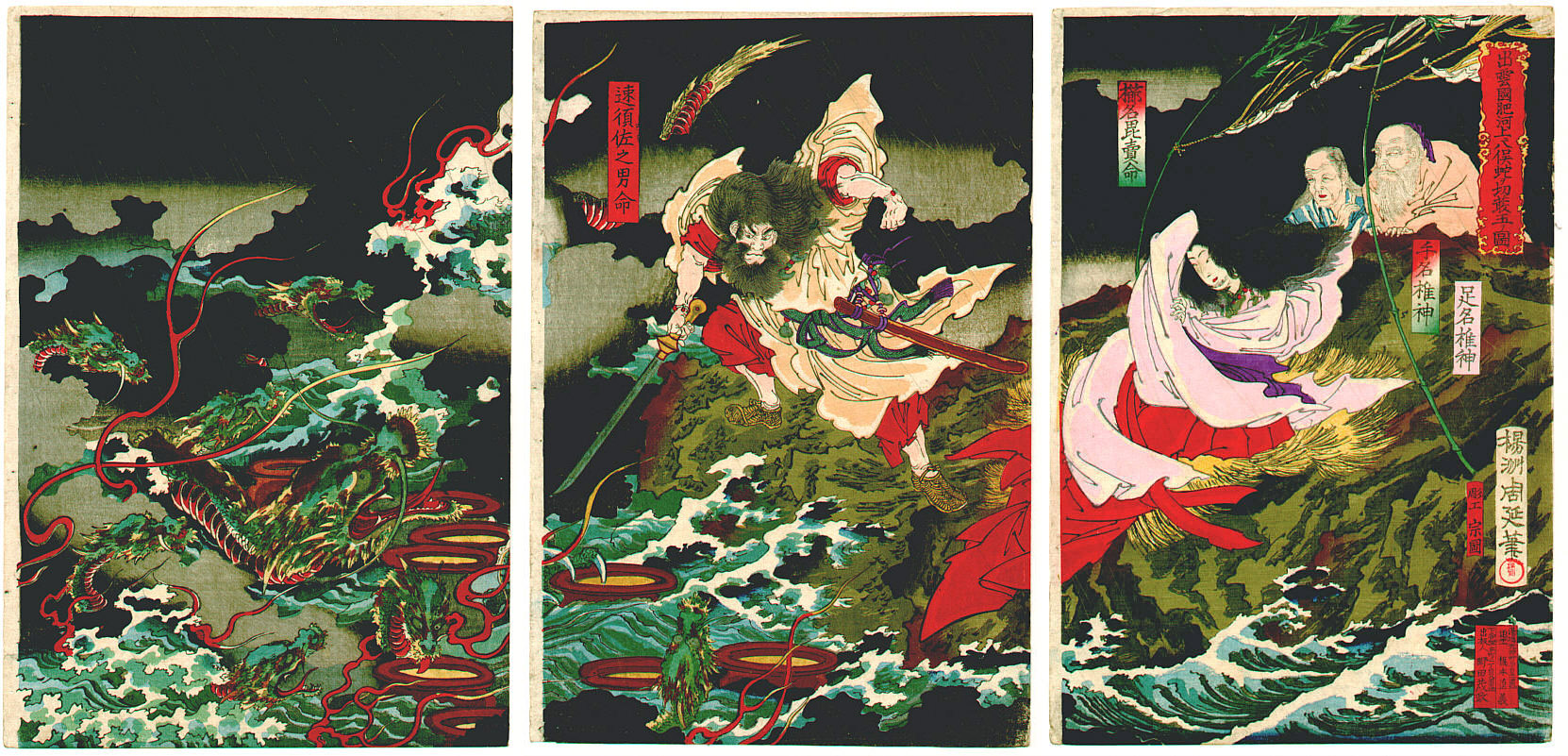
Yamata no Orochi
yamata-no-orochi
Also known as: Eight-Headed Serpent、Great Eight-Forked Serpent
A monstrous eight-headed, eight-tailed serpent from Izumo mythology who demanded yearly sacrifices of young women until slain by the storm god Susanoo. Its tail concealed the legendary sword Ame-no-Murakumo.
- Era
- Ancient
- Region
- Chugoku
- Type
- Water Yokai、Animal Yokai、Oni
Overview
Yamata no Orochi is the greatest monster of Japanese mythology — an enormous eight-headed, eight-tailed serpent who inhabited the Izumo region (modern Shimane Prefecture) and terrorized its people by demanding annual sacrifices of young women. Its legend, recorded in both the Kojiki (712 CE) and Nihon Shoki (720 CE), culminates in a battle with the storm god Susanoo no Mikoto, who defeats the creature through cunning rather than brute force. From the serpent's body emerges the legendary sword Ame-no-Murakumo no Tsurugi — later known as Kusanagi — one of the three imperial regalia of Japan.
Description
The Kojiki describes Yamata no Orochi in terms that convey its cosmic scale. Its body spans eight valleys and eight hills. Its belly is perpetually inflamed and bloodied. Its back is covered in moss, cypress trees, and cedar trees — as though the creature's body had become a landscape unto itself. Its eyes burn red like the winter cherry. This description emphasizes not just the serpent's size but its age and rootedness in the land: Yamata no Orochi is not merely a large snake but a being as old and permanent as the mountains themselves.
The Slaying of Yamata no Orochi
Susanoo, having been expelled from the heavenly realm, descended to Izumo, where he encountered an elderly couple weeping bitterly. They explained that Yamata no Orochi had already devoured seven of their eight daughters and was due to come for the eighth, Kushinadahime, that very year. Susanoo offered to destroy the serpent in exchange for Kushinadahime's hand in marriage.
His plan was elegant: he transformed Kushinadahime into a comb, which he placed in his hair for safekeeping, then instructed the couple to brew extraordinarily potent sake and fill eight large vats with it. When Yamata no Orochi arrived and each of its eight heads drank from one of the vats, it fell into a stupor. Susanoo then drew his sword and cut the creature to pieces. When he reached the tail, his blade chipped — sensing something unusual within, he carefully dissected the tail and found hidden inside it the magnificent sword Ame-no-Murakumo no Tsurugi, which he presented to the sun goddess Amaterasu.
Mythological Significance
Scholars have offered several interpretations of the Yamata no Orochi myth. One influential reading identifies the eight-headed serpent with the Hii River (now the Natori River) of Shimane Prefecture, whose eight tributaries run red with iron ore — connecting the "red belly" of the serpent and its defeat to the ancient iron-smelting culture of the Izumo region. In this reading, the slaying of the serpent represents the heroic control of a dangerous, flood-prone river system, and the emergence of the divine sword from its body encodes the connection between iron ore, water, and the metallurgical arts.
Yamata no Orochi remains one of Japan's most recognizable mythological monsters, appearing constantly in art, literature, theater, and modern media. The image of a multi-headed serpent drunk on sake has inspired depictions across every era of Japanese cultural production.
Sources
- 『Kojiki』 O no Yasumaro (712)
- 『Nihon Shoki』 Toneri Shinno (720)
Related Yokai
Amanojaku
amanojaku
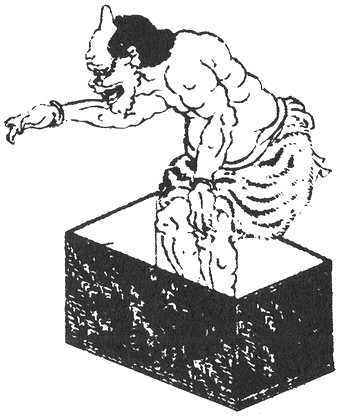
A small, perverse demon that reads human hearts and does the opposite of what is desired. Famous as the villain of folk tales like Uriko-hime, and depicted in Buddhist sculpture as a creature trampled underfoot by guardian deities.
Azuki-Arai
azuki-arai
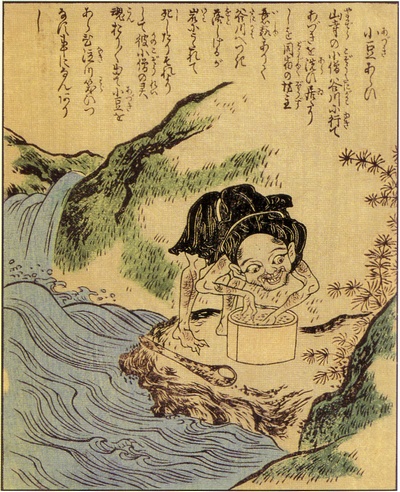
A yokai heard but rarely seen, washing azuki beans by a riverbank at night.

Azuki-Babaa
azuki-babaa
A dangerous old-woman yokai who scrapes azuki beans in mountain streams. Related to the azuki-arai but more specifically formed and more actively threatening.