
Yuki-Otoko
yuki-otoko
Also known as: snow man、Japanese yeti
A giant ape-like humanoid said to inhabit the Japanese Alps and Tohoku highlands. Japan's counterpart to the Himalayan yeti, with numerous modern sighting accounts.
- Era
- Unknown
- Region
- Chubu、Tohoku
- Type
- Mountain Yokai、Weather Yokai
Overview
The yuki-otoko ("snow man") is a large, bipedal, fur-covered humanoid reported in the high mountain zones of central and northeastern Japan — particularly the Japanese Alps (both the Northern and Southern Alps) and the peaks of Tohoku. Analogous to the Himalayan yeti and the North American Bigfoot, the yuki-otoko occupies a distinctive position in Japanese supernatural tradition as a being that straddles the boundary between folklore and cryptozoology.
Sighting Accounts
Sighting reports increased dramatically from the Meiji period onward, as organized mountaineering opened the high peaks to regular human traffic. The most commonly reported evidence consists of large bipedal footprints in snow, encountered at altitudes where bears do not typically travel. Eyewitness accounts describe a creature standing two to three meters tall, covered in gray-white fur, moving rapidly on two legs.
One of the earliest documented reports dates to 1906 in the Tateyama mountains of Toyama Prefecture. Later decades produced accounts from prominent mountaineers, and the 1960s–1970s saw dedicated yuki-otoko expeditions and magazine investigations. In 1994, a Japanese television network organized a formal search expedition in the Nagano highlands.
Traditional Roots
The yuki-otoko did not emerge from nothing. Traditional Japanese folklore about mountain people (sanjin, yamabito) — semi-human beings living deep in the mountains, beyond the reach of civilization — is ancient and widespread. These mountain-dwelling others were variously described as hunters who had abandoned human society, supernatural beings associated with mountain gods, or creatures entirely outside human classification.
The modern yuki-otoko fused this older tradition with the twentieth-century international discourse about cryptid ape-men, producing a figure that is simultaneously a continuation of folk belief and a product of modern popular culture.
Proposed Explanations
Skeptical analyses of yuki-otoko reports typically focus on misidentification of large bears (the Japanese black bear can stand on its hind legs and leave impressive tracks) or the distorting effects of snow conditions on ordinary animal footprints. No physical specimen has been collected. The yuki-otoko remains, for the moment, a creature of testimony rather than evidence — which may be exactly what it has always been.
Sources
- 『Hokuetsu Seppu』 Suzuki Bokushi (1837)
Related Yokai
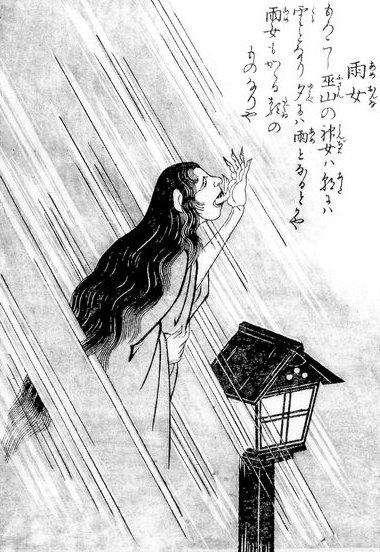
Ame-onna
ame-onna
A woman yokai associated with rainfall, appearing on rainy nights as a drenched figure sometimes carrying an infant, connected to both weather spirits and the spirits of women who died in childbirth.
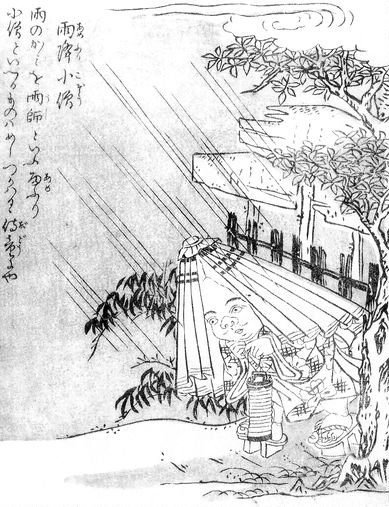
Amefuri-Kozo
amefuri-kozo
A rain sprite from Edo-period illustration, depicted as a small boy in a straw hat and rain cloak whose appearance heralds or brings rainfall.
Azuki-Babaa
azuki-babaa
A dangerous old-woman yokai who scrapes azuki beans in mountain streams. Related to the azuki-arai but more specifically formed and more actively threatening.