
Nomori
nomori
Also known as: field guardian
An old man yokai from Toriyama Sekien's Gazu Hyakki Yagyo, depicted holding a great mirror. Once a mortal guardian of the fields, transformed over time into something uncanny.
- Era
- Edo Period
- Region
- Nationwide
- Type
- Mountain Yokai
Overview
The nomori ("field guardian" or "plain watcher") appears in Toriyama Sekien's Gazu Hyakki Yagyō (1776) as an elderly man clasping a large mirror. Sekien's annotation describes him as a nomori no okina — a venerable old man who has watched over the fields for so long that he has transformed into something supernatural. The mirror he carries reflects not the mundane world, but something far stranger.
Connection to Noh Drama
Sekien's nomori draws directly from the noh play of the same name, Nomori. In that drama, a traveling monk encounters an aged field-warden, who produces a great mirror and shows within it visions of hell. The old man is eventually revealed as a demon or deity in disguise — a guardian presence that has passed beyond the boundary separating human from supernatural.
Sekien took this theatrical archetype and recontextualized it as a genuine yokai entry in his Night Parade of a Hundred Demons, giving the nomori a place in the canon of Japanese supernatural beings.
Nature and Symbolism
The nomori is fundamentally a guardian figure — benevolent toward those who respect the land, dangerous to those who despoil it. This dual nature connects him to the broader Japanese tradition of satogami (village deities) and protective earth spirits whose goodwill depends on proper human behavior.
The transformation of an elderly human guardian into a yokai reflects a key concept in Japanese supernatural folklore: that extreme devotion to a place or cause, sustained across many years, can cause a person to cross the threshold between human and spirit. The nomori has watched the fields so long that he has become part of them.
The Mirror Motif
The large mirror the nomori carries is symbolically rich. In Japanese tradition, mirrors are sacred objects — among the three imperial regalia — associated with truth, revelation, and the spirit world. A mirror that shows hell rather than the viewer's reflection inverts the protective function of the sacred mirror, suggesting that long proximity to the earth and its cycles has given the nomori insight into both the world above and the world below.
Sources
- 『Gazu Hyakki Yagyō』 Toriyama Sekien (1776)
Related Yokai
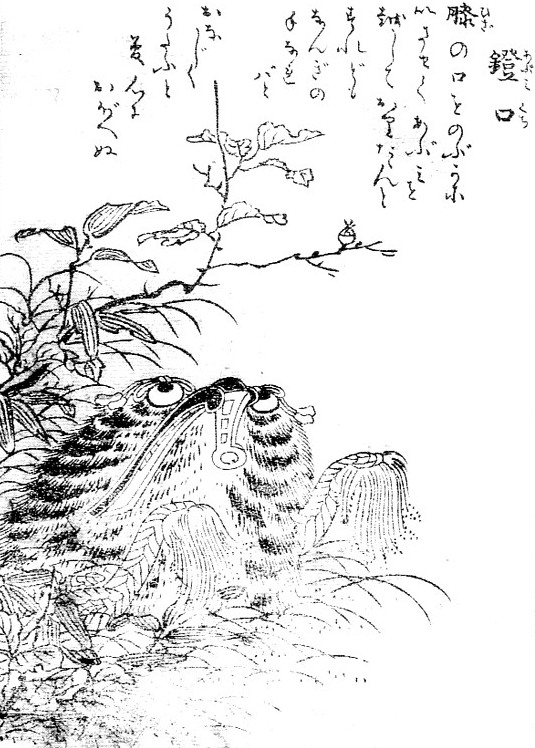
Abumi-guchi
abumi-guchi
A tsukumogami born from a horse's stirrup abandoned on a battlefield, still waiting for the master who never returned — grief and loyalty made monstrous.
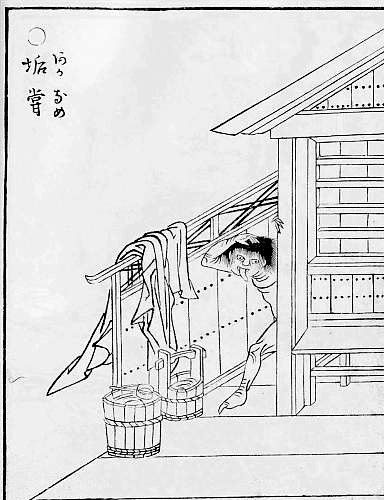
Aka-name
aka-name
A yokai that visits neglected bathrooms to lick up the accumulated grime and scum — harmless to people, but a vivid supernatural reminder to keep the bath clean.
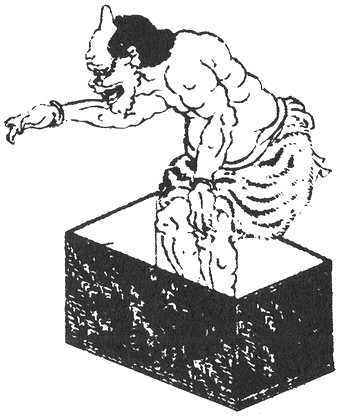
Amanojaku
amanojaku
A small, perverse demon that reads human hearts and does the opposite of what is desired. Famous as the villain of folk tales like Uriko-hime, and depicted in Buddhist sculpture as a creature trampled underfoot by guardian deities.