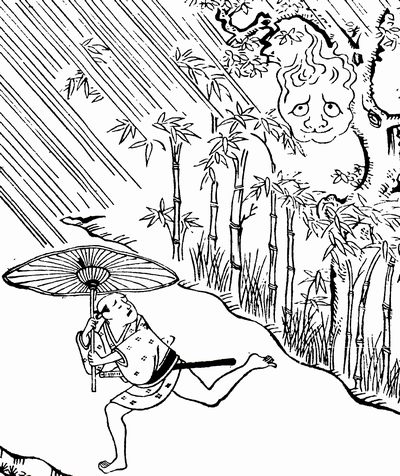
Tsurube-Otoshi
tsurube-otoshi
Also known as: well-bucket dropper
A yokai that lurks in ancient trees and drops a huge face or body down onto people walking beneath, fast as a falling well-bucket.
- Era
- Edo Period
- Region
- Kinki、Chubu
- Type
- Mountain Yokai、Animal Yokai
Overview
The tsurube-otoshi takes its name from the tsurube — the wooden bucket dropped on a rope to draw water from a well. The name captures its defining action: something falling from a great height with sudden, irresistible speed. The yokai dwells high in old trees, particularly the Japanese hackberry (enoki), and plummets down without warning onto anyone who walks below after dark.
What exactly falls varies by tradition: a massive disembodied face, a severed head, or a whole creature descending through the branches.
Appearance
Toriyama Sekien included the tsurube-otoshi in his Gazu Hyakki Yagyō (1776). His illustration shows a long-limbed, wide-faced creature lowering itself through tree branches, its disproportionately large head the focus of the composition. This image — the enormous face descending through darkness — has defined the yokai's visual identity ever since.
Regional Traditions
Traditions are especially dense in the Kinki and Chubu regions: Mie, Nara, and surrounding prefectures have the most documented accounts. Specific old hackberry trees were locally named as the haunts of the tsurube-otoshi, and the warning "don't pass under the old enoki at night" was passed down through generations.
The word tsurube-otoshi also appears in a Japanese proverb about autumn — hi ga tsurube-otoshi no you ni ochiru ("the day drops like a well-bucket"), describing how rapidly the sun sets in autumn. This double meaning ties the yokai to the liminal danger of dusk, the transitional hour when supernatural encounters were most feared.
Interpretation
Old trees held deep spiritual significance in Japanese folk belief, regarded as dwellings of gods or ancestral spirits. The tsurube-otoshi can be read as the malevolent manifestation of a tree-spirit that has grown dangerous with age. On a more practical level, the warning to avoid old trees at night carried real safety value: large branches do fall, and in an era of no artificial lighting, the forest at night was genuinely hazardous.
Sources
- 『Gazu Hyakki Yagyō』 Toriyama Sekien (1776)
Related Yokai

Azuki-Babaa
azuki-babaa
A dangerous old-woman yokai who scrapes azuki beans in mountain streams. Related to the azuki-arai but more specifically formed and more actively threatening.
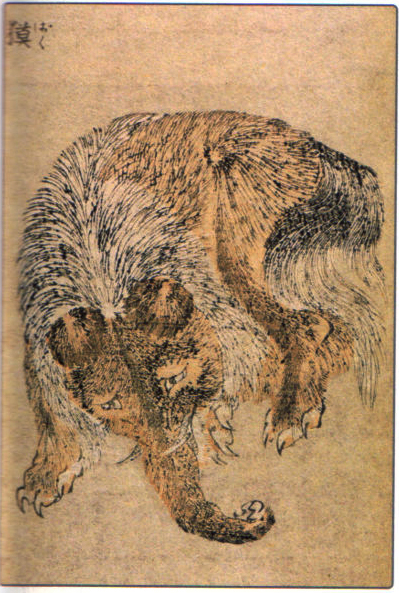
Baku
baku
A chimeric dream-eater invoked after nightmares to consume ill omens.
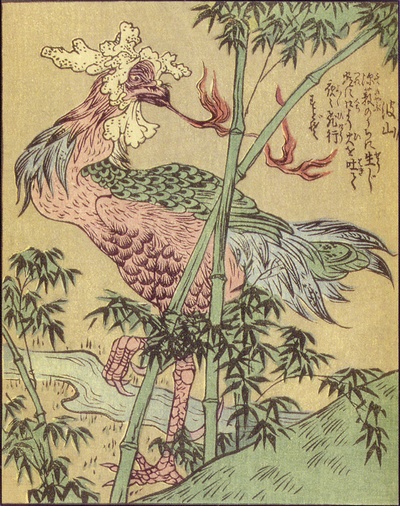
Basan
basan
A fire-breathing rooster yokai from the Kinki and Chūgoku regions of Japan. It appears at night with a distinctive flapping sound, breathes flames, and vanishes before anyone can get a clear look at it.