
Yamame
yamame
Also known as: Mountain Woman、Mountain Princess
A beautiful supernatural woman inhabiting the deep mountains of Tohoku and central Japan, luring woodcutters and hunters into the wilderness. A feminine personification of the mountain's seductive danger.
- Era
- Unknown
- Region
- Tohoku、Chubu
- Type
- Mountain Yokai、Water Yokai
Overview
The yamame — "mountain woman" — is a supernatural female entity associated with the deep mountain wilderness of northeastern and central Japan. She appears to men who work or travel in the mountains — woodcutters, hunters, charcoal burners — in the form of a beautiful woman of unusual aspect, and leads them deeper into the mountains through combinations of allure, enchantment, and direct invitation. Those who follow her may lose their way entirely, emerging days later with no memory of where they were, or may vanish from human knowledge altogether. The yamame is one of the classic "mountain seductress" figures of Japanese folklore, related to the yuki-onna and yamamba but distinct in her relatively benign, entrancing rather than predatory nature.
Appearance and Characteristics
The yamame is typically described as beautiful by the standards of her time — tall, pale-skinned, with long dark hair worn loose or in a simple style. Her clothing may be plain or absent; accounts emphasizing the wildness of the mountain spirit often describe her as dressed in rough mountain garments or in nothing at all. Her movements are unusually graceful, and her voice is described as melodious and strange — not quite like a human's speaking voice, with qualities that suggest the sounds of moving water or wind through trees.
Subtle signs mark the yamame as other than human. Her skin may be too smooth, too cold, or slightly luminescent. Her feet may not leave footprints, or she may be observed walking across streams without entering the water. She does not seem to experience hunger or cold as a human would, and she speaks of the mountains with the intimate knowledge of someone who has lived there for centuries.
Yanagita Kunio and the Tono Tradition
Yanagita Kunio's landmark work Tono Monogatari (1910) — a collection of folk beliefs and legends from the Tono region of Iwate Prefecture — includes references to mountain women and the mysterious strangers encountered in mountain environments. Tono's tradition of "yamaotoko" (mountain men) and associated female figures represents one of the most carefully documented versions of Japan's widespread mountain spirit beliefs. The yamame specifically, or closely related mountain women, appear throughout the mountain folklore of Tohoku and the Japanese Alps.
Symbolism and Interpretation
The yamame can be read as the personification of the mountain environment's ability to disorient and absorb those who enter it. Mountains in Japan have always been spiritually significant — sites of ascetic practice, divine presence, and danger. The mountain woman who leads men away from their paths and families may represent the mountain's own tendency to claim those who come to it too carelessly or who are drawn too deep by the beauty of the natural world. Some interpretations read the yamame as a mountain deity's daughter or aspect, whose "seduction" of mortals is less about desire than about a fundamental incompatibility between human life and the mountain's timescale.
Cultural Legacy
The yamame tradition feeds into a broad tradition of mountain-woman figures in Japanese art and literature, from the protective mountain goddess to the dangerous seductress to the lonely spirit seeking human companionship. In modern Japanese media, the mountain woman archetype appears in fantasy literature, games, and anime, often embodying the tension between human civilization and the wilderness that surrounds it.
Sources
- 『Tono Monogatari』 Yanagita Kunio (1910)
Related Yokai
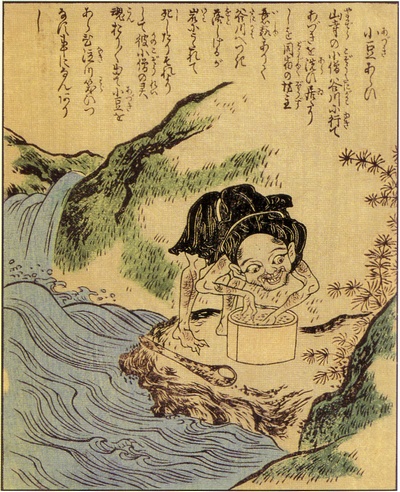
Azuki-Arai
azuki-arai
A yokai heard but rarely seen, washing azuki beans by a riverbank at night.
Azuki-Babaa
azuki-babaa
A dangerous old-woman yokai who scrapes azuki beans in mountain streams. Related to the azuki-arai but more specifically formed and more actively threatening.
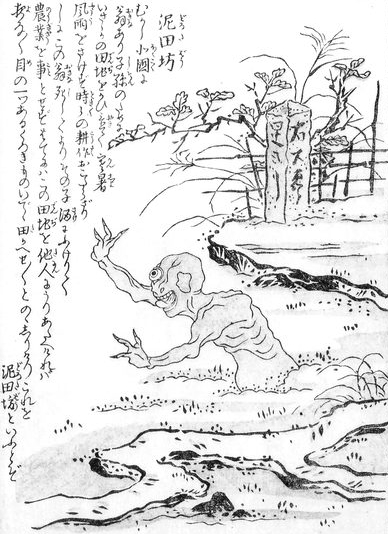
Dorotabō
dorotabo
The vengeful spirit of an old farmer whose children sold his beloved rice paddies, rising from the mud at night with three-fingered hands raised, crying for his fields to be returned.