
Yatagarasu
yatagarasu
Also known as: Three-Legged Crow、Eight-Span Crow
The three-legged sacred crow that guided Japan's legendary first emperor through the wilderness — a solar deity's messenger and the divine symbol of guidance, now emblazoned on Japan's national football team.
- Era
- Ancient
- Region
- Kinki
- Type
- Divine Beasts、Animal Yokai
Overview
Yatagarasu, the "Eight-Span Crow," is one of the most celebrated divine beings in Japanese mythology — a colossal three-legged crow sent by the heavenly gods to guide Emperor Jimmu, Japan's legendary first emperor, through the wilderness on his eastward campaign to establish the Yamato state. Its name refers to its great size ("yata" means approximately eight hand-spans across, denoting something vast), and its three legs connect it to an ancient Asian symbol of the sun. As the divine guide who made Japan's founding journey possible, yatagarasu represents the sacred act of showing the way.
The Founding Myth
According to the Kojiki and Nihon Shoki, the two oldest chronicles of Japanese myth and early history, Emperor Jimmu led his forces from the western island of Kyushu eastward toward the Yamato region (present-day Nara Prefecture). When the campaign reached the rugged mountains of the Kumano region and the army became lost in impenetrable wilderness, the heavenly deity Takamimusubi dispatched yatagarasu to serve as guide. The crow led the imperial forces safely through the mountains to victory, thus enabling the founding of the Japanese state.
The Three Legs and Solar Symbolism
The three-legged crow is not unique to Japan — it appears in the mythologies of China and Korea as a solar bird. In Chinese tradition, a three-legged crow (jīn wū, the "golden crow") was said to live inside the sun, making it a direct embodiment of solar energy. The number three carries sacred weight in many traditions as the number of heaven, earth, and humanity, or of past, present, and future. In Japan, yatagarasu is therefore understood as both a solar deity's messenger and a bird whose three-legged form encodes cosmological meaning.
Kumano and Modern Legacy
The Kumano region of western Japan — encompassing the three great Kumano shrines and the pilgrimage roads connecting them — maintains the closest living relationship with yatagarasu. The bird serves as the sacred messenger (shinshi) of the Kumano shrines, and its image appears throughout the region on talismans, shrine decorations, and local products. The Kumano Kodō pilgrimage routes, designated a UNESCO World Heritage site in 2004, use yatagarasu as their symbol. Most famously in contemporary Japan, the Japan Football Association has used a yatagarasu emblem as its official logo since 1931, connecting the ancient guiding crow to the modern national team's quest for victory.
Sources
- 『Kojiki』 Ō no Yasumaro (712)
- 『Nihon Shoki』 Prince Toneri (720)
Related Yokai
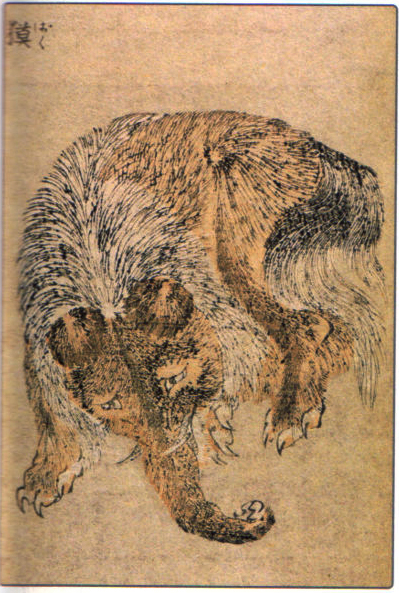
Baku
baku
A chimeric dream-eater invoked after nightmares to consume ill omens.
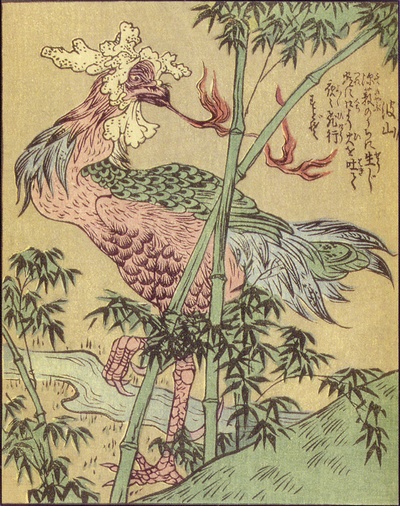
Basan
basan
A fire-breathing rooster yokai from the Kinki and Chūgoku regions of Japan. It appears at night with a distinctive flapping sound, breathes flames, and vanishes before anyone can get a clear look at it.

Futa-kuchi-onna
futa-kuchi-onna
A woman with a second mouth on the back of her head that secretly consumes food, with hair that moves like a snake to feed it.